I. Spotlight
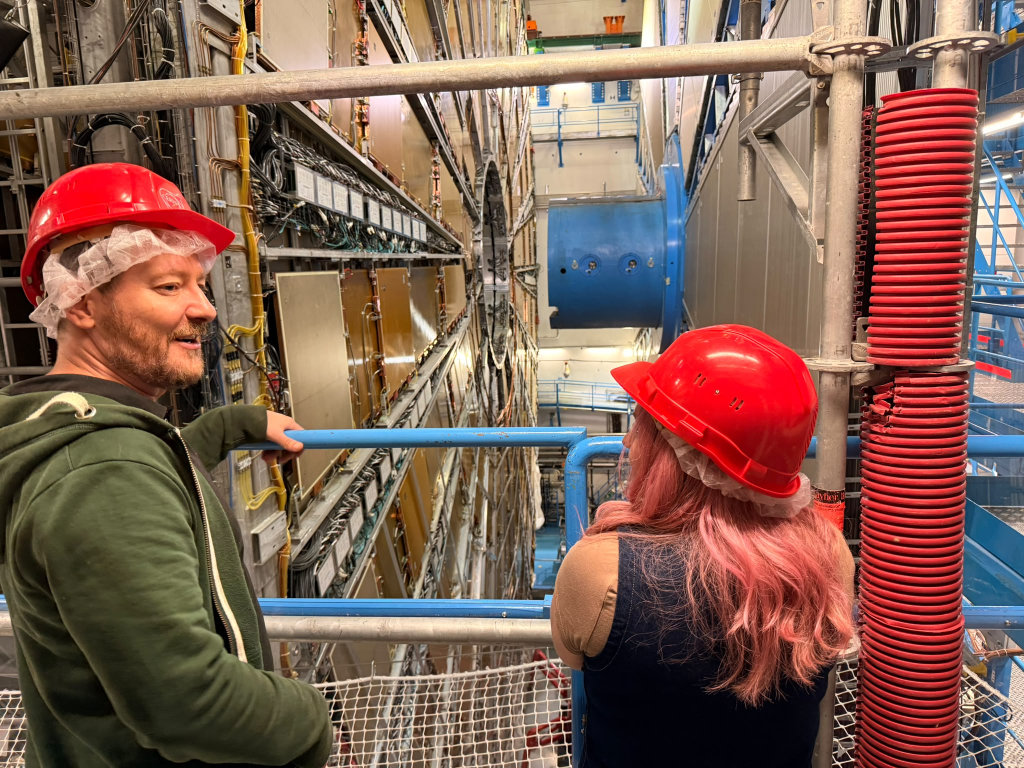
The folks at EnWorld got to visit the research lab at CERN (yes, that one, with the very big machine that looks at very small things) where they apparently have a pretty big games club.
“During an interview, Michael Davis put forward the theory that the work done by the Large Hadron Collider is, in one sense, a giant game. “All games you can really think of as a simulation of some kind. Chess is a simulation of two armies battling over two kingdoms. When we play role playing games, we’re simulating maybe a historical period or a fantasy world.” Just as our games simulate fantasy worlds, medieval combat, or starship battles, the LHC is simulating the very birth of the universe. It is, in a way, LARPing the Big Bang. “That’s what we’re doing in the LHC. Where we’re learning from this simulation of the universe, and that’s what we’re doing in games.”
II. Media of the Week
- Dice Exploder’s new season had a great episode where the “mechanic” being discussed was the Thri-Kreen from D&D’s Dark Sun setting. There’s some cool conversation about what it means to play someone with a completely alien body and personality.
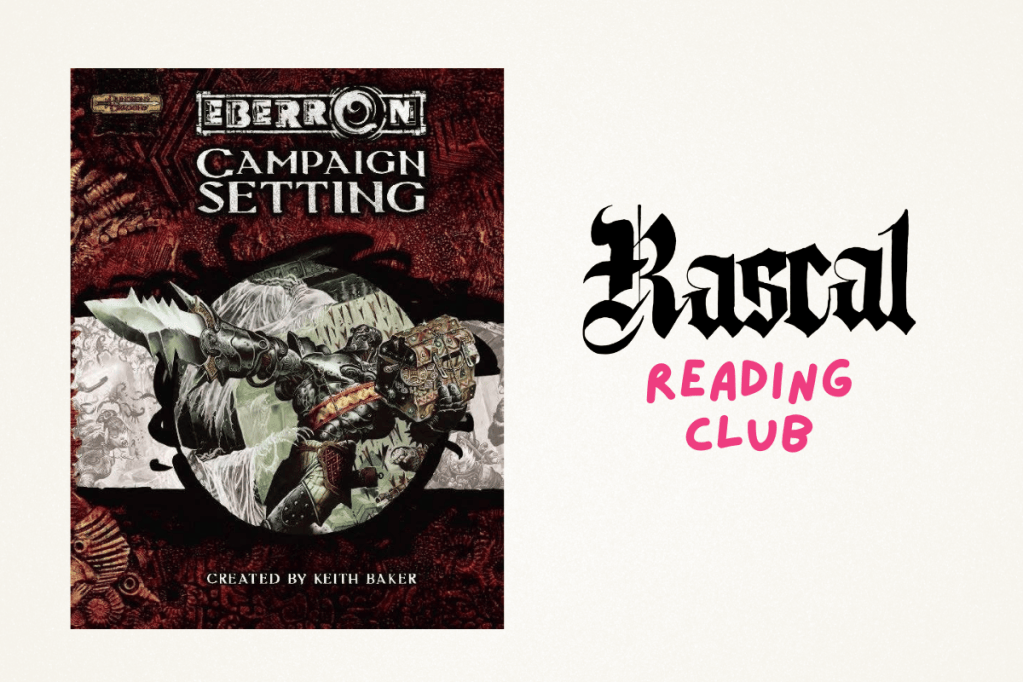
- The Rascal Reading Club continues its setting season with two episodes about Eberron. We talk about the “encyclopedia” style of worldbuilding, critique the entire genre of fantasy, giving monsters the spotlight, and also the ways Eberron is pretty cool.
- Duamn Figueroa joins me for the talkback and shares his experiences of discovering the game when he was 16 and the influence it had on him.
- You too can support the newsletter on patreon!
III. Links of the Week
- The D&D and Magic the Gathering teams are unionizing. While Wizards has refused to voluntarily recognize the union, there will be a vote soon (and the outcome of that seems to point towards the union having the vote), which means Wizards might soon be a unionized workplace.
- Asa from Backwards Tabletop asked me some questions about theatre and RPGs (drawing from my past life as a playwright type). It’s a fun conversation for me because I mostly resist answering any of his questions straight.
- BoardGameWire does some really good reporting about the business of board games and in their latest deep dive, they dissect the collapse of Steamforged’s board game business, which leaves around 18 million in crowdfunding in limbo with little clarity on when backers will get their games.
- On Rascal, I speak to Aaron Trammel about his new monograph that looks at some of the cultural causes behind D&D’s design. The thesis is basically that the ideology of “game design is putting numbers to things” and “everything from far away is weird and dangerous” combines to give the game some of its problems that people have been moving away from, more or less since the game has existed.
- Mint blogs from about three games that she ran at conventions: Rebel Scum, Summer/Camp, and Operational Final Monarch:
Out of all of the games I’ve played this year, I think Operation Monarch might just be my new favourite. The gambling mechanic is sublime – hiding a d20 under a cup ratchets up the tension in the most beautiful way, and watching players work out the odds of adding yet another d4 to their pool against the possibility of rolling a 1 is so sweet to watch.
- Whose Measure God Could Not Take has a couple of cool blogposts full of very flavorful worldbuilding. One does a cool job of just painting in very broad strokes the archetypes of opposition that might exist in your world and the other one talks about other types of adventurers and is delightfully weird.
The Green: One man with one dream of endless power, but also a fleet of flunkies, platoons of killers vindicated by paychecks, and populations humming with adulation for this one’s man’s ambition, his heedless drive to make a buck. He believes in something beautiful; it ornaments his baseness. Everything he cannot buy he strangles, and everything he owns he neglects. With enough gold, he’ll finally be complete.
IV. What am I playing?
Been a while since I did a gaming update so here’s two!
The minimalist Daggerheart campaign continues after a break. We sketched out what the characters had been doing in downtime (being extremely successful and accumulating power, the advantage of being offscreen) and then it was my job as the GM to explain why all of that success and power was threatened and why they had to come together once more. The feeling of playing this game after that time skip is completely different.
Before, when the players came into contact with the forces that are tearing the city apart (a haunted quarter that was slowly expanding like an infection, a vampire countess creating an army of thralls without leaving her manor, and the Ayn Rand-inspired CEO who is taking over the city through sheer charisma of being a Superior Man), they were mostly powerless. Now they care about the city, this isn’t a new home, it’s just home. And they believe that they can save it. It’s really cool. Long games, time skips, playing with social class, all of it’s really good.
Then, there is the Ryne x Silent Titans game. It’s a very janky fit as expected, but some of it is that Ryne is a very slow game. It’s got a lot of parts and asks you to really shave it down yourself into what you want it to be. The other part is that is the game expects you to co-create the setting, which naturally invests the players into the world more, whereas when you use it to run an adventure, that simply does not happen.
This is compounded by the fact that Silent Titans is yet another amnesia adventure. How did I do this to myself twice! (Gradient Descent being the other) Amnesia remains the ludic equivalent of hitting the break pedal on the story. It slows things down, which can be good and bad. We spent a long time — four or five sessions — where the players were just figuring out the world, exploring the “base” of Legion’s Fort, and deciding what to do. In the end, they find themselves trapped here and are mostly exploring because they hate the idea of hanging around that cursed city with its pompous, deranged, but sadly effective leader.
It’s really interesting to see players have to convince themselves to adventure — something that I don’t think that adventure designers think about very much. The goal of the whole game is to get enough money to leave, i.e., stop playing the game. Now, by doing this, the characters will learn about their past and the world will open up. It’s actually a very fun adventure but it hides that fact behind a cruel facade. Very strange.
Still wonderful though.
V. Small Ads
All links in the newsletter are completely based on my own interest. But to help support my work, this section contains sponsored links and advertisements. If you’d like your products to appear here, read the submission form.
- Rusałka is a card-based ttrpg about the spirits of drowned women and the mortals desperate enough to seek their magic at the secret pool. Make your wish on BackerKit!
- Virtual Battle Mat feels like a real table. Minis stand up, maps sprawl, friends talk face to face. All in a browser, one link, free forever. vbm.games
- Honest Dice Kickstarter! Beautiful, limited edition, hand-poured dice 🔥 Engineered to increase fairness with mathematically balanced numbering. Tested w/15,000 rolls. Already made, US delivery in time for Christmas!
This newsletter is sponsored by the wonderful Bundle of Holding. Check out the latest bundles below:
- Cthulhu Awakens, Green Ronin’s game of Lovecraftian mythos using their AGE system.
- Also, fans of the mythos can check out these game books and graphic novels from Blue Fox.
- Grab all of Evil Hat’s new expansions for Monster of the Week including world codexes and the team mechanics.
Hello, dear readers. This newsletter is written by me, Thomas Manuel. If you’d like to support this newsletter, share it with a friend. If you’d like to know more about my work, check out the coolest RPG website in the world Rascal News or listen to me talking to other people on the Yes Indie’d Podcast.


Leave a Reply