I. Spotlight
One of the cool things that has come out of success of Mythic Bastionland is that people are riffing off how the handles hexcrawling. The elegance of “an escalating series of encounters that could be triggered anywhere” has led to what one blog is calling the Mythic Engine.
The essential idea is to take everything that would normally be done as keyed locations in a map or static lore and turn them into the aforementioned “quantum” encounters, i.e., everything works like a myth. Or to put it another way, everything is a Front from Apocalypse World. And then as you explore the world, you trigger these encounters and the world blossoms before you.
3x5Arcana summarized it on an index card but there’s value in reading the whole thing.
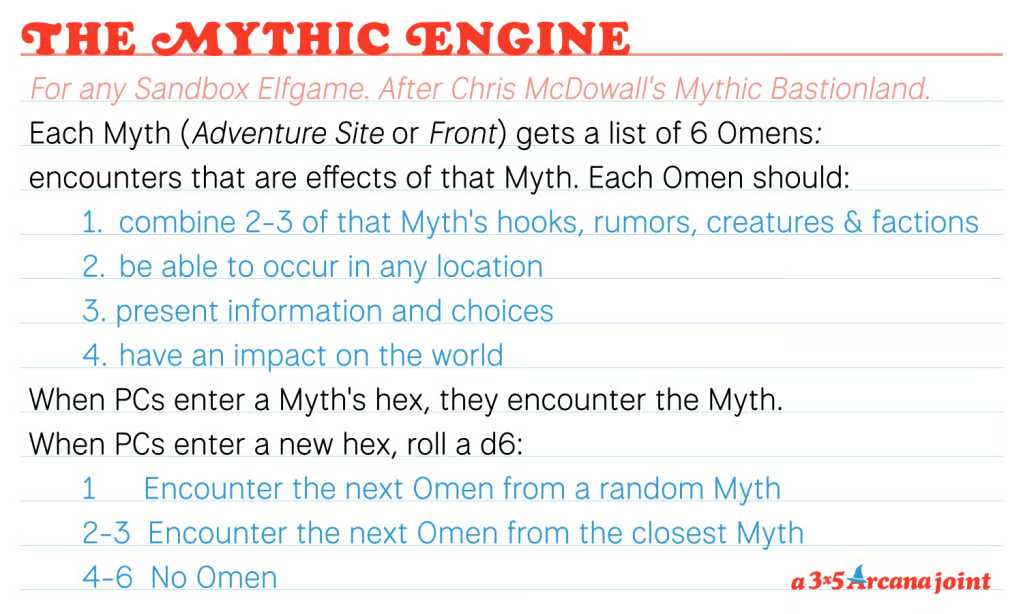
There’s still a lot of work in that step that “says write 6 omen encounters by combining 2-3 elements of the world together” but once it’s done (or the designer does it for you), it does become, as the post says, an engine.
II. Media of the Week
- I interviewed Chrys Sellers about her game Defy the Gods on Yes Indie’d. It’s a nice conversation about the game’s design and how it played out for me when I ran a short campaign based on its quickstart. We talk about what it means to make a game that has to be queer and sword & sorcery and what those together mean.
- If you want to read more about what sword & sorcery is up to in 2026, this interview with writer Bryn Hammond is a good read.
- You too can support the newsletter on patreon!
- If you’ve released a new game on itch.io this month, let me know through this form so I can potentially include it in the end of the month round-up.
III. Links of the Week
- The development of Apocalypse World 3e, because it’s released in stages, has prompted a lot of cool discussion, including a three article series that explores how moves are expected to have some leeway for interpretation. Most people who have played these games have probably stretched moves multiple times, but over a series of blogs, Vincent Baker lays out how that’s an expected and supported outcome — an affordance of the game’s design, not something that goes against it.
- Sean Guynes, critic and scholar, who writes the Genre Fantasies blog is starting a new project where he’s reading through D&D novels. If you want to read a smart person dissecting dissecting those books, you can follow along.
- Valeria writes about introducing her dad to RPGs through Mothership: “In five years’ time I expect the MoSh-heads will be running games off beveled runic script; each glide of their fingertips sightlessly absorbing information like a living barcode scanner.”
- Clayton Notestine’s newsletter has a great series of links (including to the Rascal Reading Club) and I’ll highlight this collection of crowdfunding advice from the designer of Perils & Princesses.
- Sam Dunnewold write a cool piece about his game was a collection of his best practices as a player: “I want every scene to be like the diner scene in Heat, DeNiro and Pacino facing off, and that’s what it feels like when two PCs go up against each other or even just come together to circle up and make a plan.”
- I enjoyed reading Kieron Gillen’s post about playtesting his new game, Scions, specifically the parts about how it didn’t work which often don’t make it into the retrospectives.
- For Rascal News, I wrote about what might be the last official Fate game to ever come out from Evil Hat. It’s based on an interview with Fred Hicks and sketches out how Fate’s development through the early internet is why it’s cool and why it might make sense that Evil Hat don’t pursue it anymore.
- I also talked about a new RPG based on an Adrian Tchaikovsky novel that I wrote about on the newsletter ages ago.
IV. What am I playing?
The last couple weeks have had some tremendous gaming. Apocalypse World: Burned Over continues to be one of the best games I’ve had with my home group. So much seems to happen every session, with the world changing radically every time any scheme comes to a head.
Band of Blades continues and in a delightful turn of events, things have boiled over to such an extent that we’ve been in a 3-session (2 hours each, so roughly 6 hours) downtime in one location. Usually, we move quickly one mission, one downtime, and then the legion continues their journey. But this time, almost right before the end of the campaign, the legion has become the centre of some intense philosophical and personal stakes and no one’s ready to move on until it’s resolved. One of my players even wrote about the game here.
Unlike the AW game, this game is technically slowing down rather than speeding up. Which just goes to show how much the idea of “speed” doesn’t really matter. While that campaign is exciting because of how fast things are moving, this campaign is peaking because of how much we want to slow down and draw this one moment out.
Daggerheart is also going so well. We still haven’t had a single combat (and we’re at least 4-6 sessions in, oops). This game is the classic fantasy RPG experience for me because of how much we go from goofing off to serious or spooky. These oddball fantasy characters are doing shenanigans but the outcome has been slowly and inevitably getting pulled into the seedy underbelly of the city and the various plots cooking under the surface. They’ve so far discovered a ghost that wants to destroy the city by infecting everyone with haunted music and a cult that seems to have made a giant glass snake. They’ve also been pulled into joining two different rival criminal organisations and are desperately trying to extricate themselves before their new employers find out about each other.
It’s going really well but I’m reminded that running a trad game with little to zero prep is one of the hardest ways to do it. I’ve got no module and the system isn’t particularly generative. I think that it’s worked this well because one player has consistently chosen to make the most tremendously bad (and thus very fun) decisions and also I’m falling back on running the game like Blades in the Dark. I’m not changing the rules but I’m using the same mindset: bringing the city to life via the unwritten rules of Doskvol.
It’s tricky to talk about easiness and difficulty so I’m going to try and be more explicit about what I mean: Five years ago, I would’ve found running a completely improvised trad game very difficult — I would’ve still tried to do it but it would’ve been less good and I would’ve been frustrated. But right now, it’s easy and great. So if Thomas from five years ago would’ve reviewed Daggerheart, he would’ve rated it worse than Thomas today. Who’s correct? Both? Neither?
I’m not trying to say it’s an intractable problem: I can review this game in a straightforward way by just being honest, as I did above. It’s not about how hard it is to objectively talk about games. It’s about why I find it hard to disagree with someone else’s review or experience of the game even if it’s different from mine. If it doesn’t fit into the gamut of experiences I think is possible, then I need to expand what I think is possible.
Essentially, I’ve realized I have two options when talking about games: focus strictly on my own personal experience (and avoid talking about the game in generalities) or embrace the gamut of experiences possible with the game (and thus devalue any individual opinion). In both cases, it’s serious work to declare a game good or bad. The first one requires honesty & vulnerability and the second one requires humility & research.
V. Small Ads
All links in the newsletter are completely based on my own interest. But to help support my work, this section contains sponsored links and advertisements. If you’d like your products to appear here, read the submission form.
- Virtual Battle Mat: the simplest VTT online. Drop a map, place tokens, play. Voice and video built in. No rules engine, any system. Feels like a real table. vbm.games
This newsletter is sponsored by the wonderful Bundle of Holding. Check out the latest bundles below:
- Kobolds Ate My Baby is a silly fantasy game from 9th Level Games that comes with 11 original adventures.
- There are also two spaghetti fantasy Brancalonia bundles — the core one as well as a new one with all the latest supplements.
- Also, hundreds of Dyson Logos’ dungeon maps!
Hello, dear readers. This newsletter is written by me, Thomas Manuel. If you’d like to support this newsletter, share it with a friend. If you’d like to know more about my work, check out the coolest RPG website in the world Rascal News or listen to me talking to other people on the Yes Indie’d Podcast.


Leave a Reply