I. Spotlight
Wil of Aggregate Cognizance writes an analysis of Blades in the Dark that both criticizes misreadings of the game as well as the game itself (but his criticisms are better).
In the article, there’s an explanation of “fiction first” that like all attempts to explain the concept doesn’t seem satisfying. Wil argues that “fiction first” is about timing: we first do the fiction, then we go to the mechanics if the fiction triggers a rule. This goes against the other common interpretation that the term means “the fiction is more important than the mechanics”, which is more nebulous. What does it mean for something to be more important? Suddenly, it’s much more difficult to pin down. Suddenly, it’s much more open to being an endless debate about subjective values.
To be clear, Wil is correct. Blades in the Dark uses fiction-first to differentiate RPGs from board games (and stuff like combat in D&D, where you almost always just need to call out your mechanical choice).
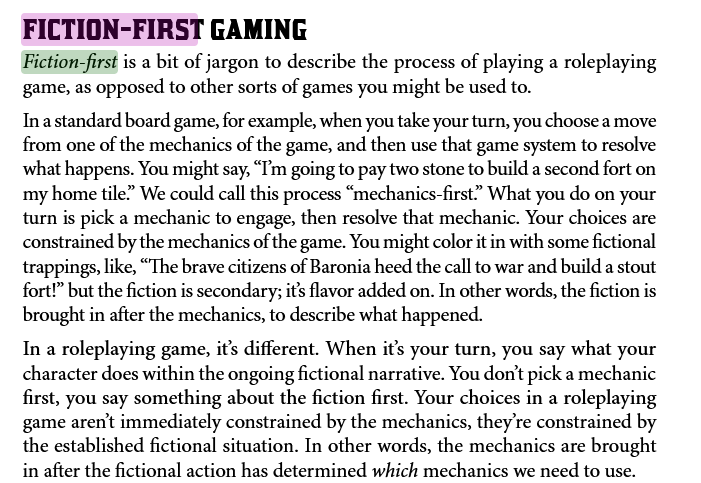
That said, I have more or less stopped using this phrase because practically speaking, you have no idea what people are taking away from it anymore. But if you say “only use a rule if it makes sense in the fiction” or “use the rule that makes the most sense”, I have found that no one has confusion about what you’re talking about anymore. In fact, it’s a sentiment that becomes immediately so uncontroversial that some people refuse to believe that this is what the phrase means. Who would argue this, they ask. Exactly. Exactly.
II. Media of the Week
- The latest episode of Quinns Quest sings the praises of Stonetop for its focus on the human compared to other fantasy games. It’s a good review and I’ve seen so many people excited to try this game as the game’s visions of a specific community-oriented model of play resonates with them.
- On a slightly related note: For Rascal News, I’ve been doing the Rascal Reading Club which in its first season is all about GM advice. The latest game was tactical fantasy game, Draw Steel. In the first episode, I read through the game’s GM sections and one of the big things was about how it tries to talk about the differences between a “heroic” game and one where the world is less binary good/evil. It was a tricky subject and I wasn’t sure we got anywhere clear but after some solid responses from listeners in the talkback episode, I feel like I’m much happier with the whole thing.
- On Yes Indie’d, I spoke to Sam Dunnewold of Dice Exploder about how his game Band-Aids and Bullet Holes comes directly out of a lot of thinking about “playing pretend” and what game design really brings to that activity.
- You too can support the newsletter on patreon!
- If you’ve released a new game on itch.io this month, let me know through this form so I can potentially include it in the end of the month round-up.
III. Links of the Week
- Isabelle Ruebsaat writes a brief post about liking rules that just imply fictional truths without dice mechanics — stuff like “you can always tell when someone is lying”.
- On Geek Native, an interview with Alessio Cavatore (Mordheim, Warhammer) and Zak Barouh (Animon) who are designing the new Ghost in the Shell RPG.
- Judd Karlman of Githyanki Diaspora writes up some ideas for what happens when you timeskip ten years in an Apocalypse World campaign.
- I read It Came From The Bookshelf just for amusing thoughts about White Wolf splatbooks at this point. The latest post is about the Kindred of the East called Dharma Book: Bone Flowers: “To be fair to Kindred of the East, putting in an entire faction of insufferable nerds, that’s just knowing your audience. (And believe me, I’m lobbing this bomb, but it’s exploding right in my face). It’s something you can work with. Every adventuring party needs a psychopath, a real horny one, someone struggling with personal identity, a humorless scold, and an absolute buzzkill who knows all the lore. That’s just rock-solid team dynamics.”
- There’s a charity bundle for raising money for disaster relief after a typhoon hit the islands of micronesia.
IV. What am I playing?
First, for Rascal, I wrote a long-ish essay about the Gradient Descent and Psi*Run campaign which became about AI in the current moment. (There’s no strict paywall anymore so please do read it. It’s very sincere but I’ll write something funny later as atonement.)
Second, I had one of those sessions of Band of Blades that reminded me about how I still sometimes end up thinking in very narrow ways when running action scenes in the game. The situation is really common: the characters come up against a foe that is much stronger than them, in principle. At the end of the session, I felt like I had done a bad job — almost none of the characters were injured and I’m not sure they ever really felt in any danger of “losing”.
This was due to a couple of reasons: my players used every mechanic in the game to their advantage (group actions, armor, resistances) and on top of that, they got lucky with all their rolls. But at the same time, looking back at how things played out, the events of the session were entertaining. So one part of this is that I just need to get over this hangover about what a session where the characters face off against a dangerous enemy “should” feel like.
That said, there was one thing I strongly feel I should’ve done differently. There’s this thing in Forged in the Dark games (and PbtA) where you start to think of when you can and can’t make a GM move. It’s easy to think that a good GM in these games *only* responds to the players. That I shouldn’t just have NPCs take actions if I’m not handed a golden opportunity by the players or the dice. But that’s not true.
I spent a lot trying to make the enemies feel difficult by starting the players off at limited effect (or zero effect) and hitting them hard with consequences (when I got the chance, which was rarely). But the easiest method is always just to let the enemies act first — and it would’ve been powerful because it breaks the usual rhythm of the players always being protagonists that has been true for the majority of the campaign.
And lo, and behold, it’s actually written down in Blades:
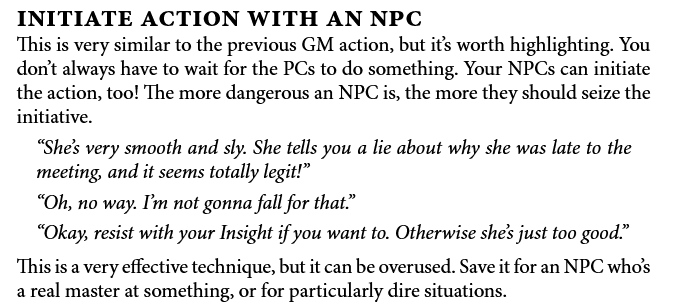
From now on, the thumb rule for me is that if I’m ever thinking that the players should have zero effect because an NPC is so bad ass, I just need to let them act first to showcase it. Simple, straightforward, dramatic. Still learning.
V. Small Ads
All links in the newsletter are completely based on my own interest. But to help support my work, this section contains sponsored links and advertisements. If you’d like your products to appear here, read the submission form.
- The Roots of Soledad is live on BackerKit! Discover what lies in wait beneath the kapok tree in this card-driven, gm-less homage to magical realism by the designer of Archipelago.
- MemoryCore is a curated anthology of 32-bit-era-inspired TTRPGs, each paying tribute to a masterpiece of the disc age. Six games, one system, zero prep. Follow the project on BackerKit.
- Honest Dice Kickstarter! Beautiful, limited edition, hand-poured dice 🔥 Engineered to increase fairness with mathematically balanced numbering. Tested w/ 15,000 rolls. Already made, ships right after the project ends!
This newsletter is sponsored by the wonderful Bundle of Holding. Check out the latest bundles below:
- The Other Side Publishing’s source books for OSR / fantasy games.
- Get the latest era of Atomic Robo comics as well as the Fate-based RPG and older comics in two bundles
- A collection of solo games like Be Like A Crow from Critical Kit
Hello, dear readers. This newsletter is written by me, Thomas Manuel. If you’d like to support this newsletter, share it with a friend. If you’d like to know more about my work, check out the coolest RPG website in the world Rascal News or listen to me talking to other people on the Yes Indie’d Podcast.


Leave a comment