I. Dear Reader,
Paranoia came out in 1984. Right at the end of the first decade of RPG publishing. It’s both a system and a setting. The setting is shenanigan-central – a city called Alpha Complex ruled by a mad AI called Friend Computer. The rules have gone through at least 6 editions but the core has been the same: dangerous missions, bumbling protagonists, slapstick outcomes. There’s secret societies (with secret objectives), abundant clones (so death is no big deal), and a lot of trying to kill each other without getting caught.
A big part of reading these older games for me is seeing patterns. What changed? What remained the same? I didn’t expect to think: what teaching tool that would be a good idea in 2024 was implemented in 1984?
In the first Player’s Handbook for Paranoia, there is a solo adventure. It’s written like a game book with instructions to “Flip to 24 if you do X, Flip to 12 if you do Y” and so on.
Here’s the first page:
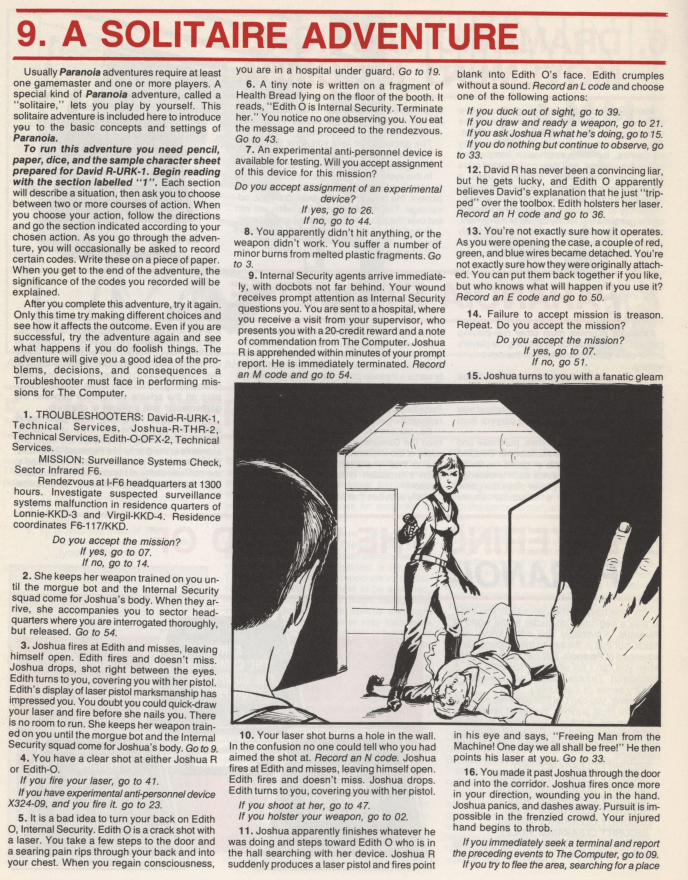
The first time I ran through it, I died before we went on the mission. Also, as I was reading, I looked at point 27 for no reason and it said, “This paragraph is not part of the solitaire adventure. Therefore, if you’re reading this, you have not followed Friend Computer’s instructions. Give yourself 1 treason point.” Oops.
You can say that I learned more about this game than the mechanics. Actually, I learned very little in terms of mechanics, just the basic form of what making a check looks like and how skills work. But it did give me a pretty good idea of what to expect from play. And that is something very valuable!
Interestingly, this is in the Player’s Handbook but thinking in terms of someone running the game, it gives you a solid picture of how a mission starts. I’ve talked about this before but a cold start is the hardest thing. Nowadays people will watch or listen to AP but for me, a solid example of play in the book is essential. This is just an example of play – except its interactive. And that is very cool.
Did any other games try this? Has anyone seen this anywhere else? Please let me know!
Yours, seeking ultraviolet security clearance,
Thomas
II. Media of the Week
- Not sure how I missed this for so long but there’s a very fun short film on the Good Times Society channel called High Stakes that won best film at GenCon. It features a bunch of people you might recognize from Dropout and things like that.
- You too can support the newsletter on patreon!
- If you’ve released a new game on itch.io this month, let me know through this form so I can potentially include it in the end of the month round-up.
III. Links of the Week
- On Rascal News, it was a good week.
- I wrote about xorvintaal, an obscure bit of D&D dragon lore, and how it made me think about the great game, a period of 19th century history where Britain and Russia were fighting over Central Asia.
- Rowan Zeoli wrote about Hurricane Helene and climate change and the publishers, designers, and players affected by all this stuff.
- On A Knight At The Opera blog, Dwiz spins a satirical tale of one 5e player’s descent into madness.
- On Fandomentals, there’s an interview with Zach Cox about making “the saddest, gayest vampires they could in Paint The Town Red“.
- On EnWorld, a review of cartoon-y space dinosaur game, Kosmosaurs.
- This is a really nice overview of Confluence, a huge RPG project with lots of different creators. It’s built around atlases, which are diagetic guides to the world.
- Explorer’s Design has a nice post trying to do a hard thing: outlining a framework for how to start designing.
- I enjoyed this post by designer GoblinCow about Mork Borg and being inspired to create.
- There’s a future bundle raising funds for hospitals in Ukraine and you can contribute a game here.
From the archive:
- Ava Islam’s great post about memory, specifically how to design with awareness about what GMs have to keep in their heads. (Issue 59, September 2021)
IV. Small Ads
All links in the newsletter are completely based on my own interest. But to help support my work, this section contains sponsored links and advertisements. If you’d like your products to appear here, read the submission form.
- Confluence: The Living Archive is a genre-blending TTRPG of fantasy, sci-fi, and horror, built to tell collaborative character and place-driven stories. Launching on Backerkit, October 15!
- Downcrawl 2E is a new edition of the TTRPG toolkit for exploring a weird, wondrous underworld of stalactite cities and fungal gods. Now supports zero-prep and solo play!
- 🎲DIE in a Dungeon is a solo/cooperative, narrative dungeon-crawl that turns your RPG dice into doomed heroes! Grab it and/or the DUNGENERATOR decks on Kickstarter 10/10!
- Explore dungeons, face deadly foes, and claim legendary loot in Slay the Dragon RPG! With streamlined rules and rapid gameplay, it’s RPG nostalgia with a modern twist.
This newsletter is sponsored by the the wonderful Bundle of Holding.
- Unknown Armies 3e, the game of occult action and intrigue, in a bundle that collects core books, campaigns and music.
- Also, 0One digital battle maps for fantasy and horror games
- Quick deal on Wulfwald, an old school mythic anglo-saxon game from publisher Lost Pages
Hello, dear readers. This newsletter is written by me, Thomas Manuel. If you’d like to support this newsletter, share it with a friend or buy one of my games from my itch store. If you’d like to say something to me, you can reply to this email or click below!


 Indie RPG Newsletter

Leave a reply to Mr. Sauli Cancel reply