I. Dear Reader,
I’ve been playing Urban Shadows 2e recently. It’s an urban fantasy game from Magpie and the first edition is pretty well-loved. It’s probably not as universally admired as their superhero game Masks but it’s up there. It was one of those games that demonstrated that Magpie had a winning formula with PbtA that they could deploy across different genres. The genre in this case was “what the designers wanted Vampire the Masquerade to be”. You’ve got vampires, werewolves, imps, fae, humans (john wick, constantine, suchlike) and they’re all dressed in black, wearing shades, and scheming (flirting) in the night.
There’s lots of interesting bits of design here, but I want to talk about Debt.
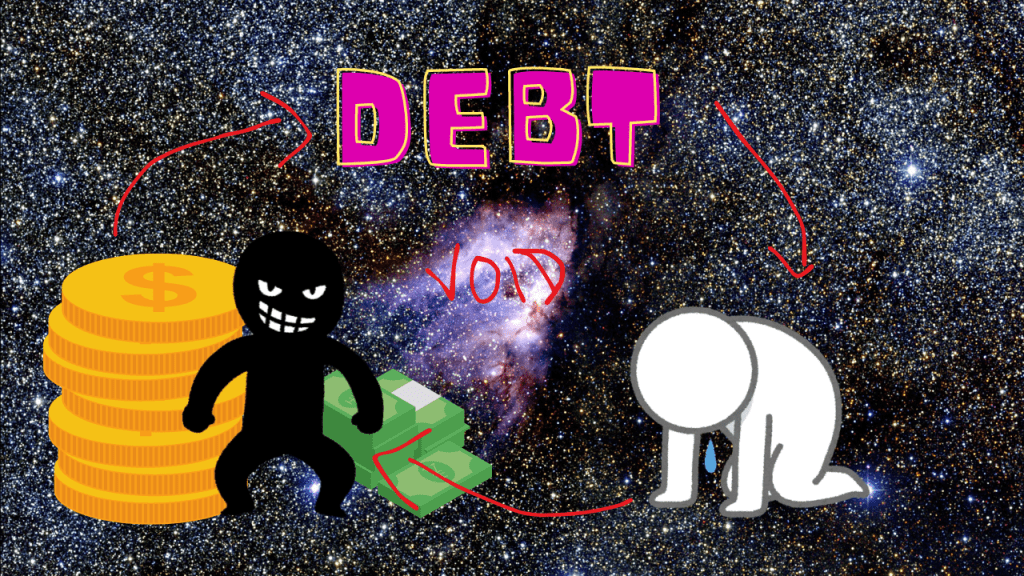
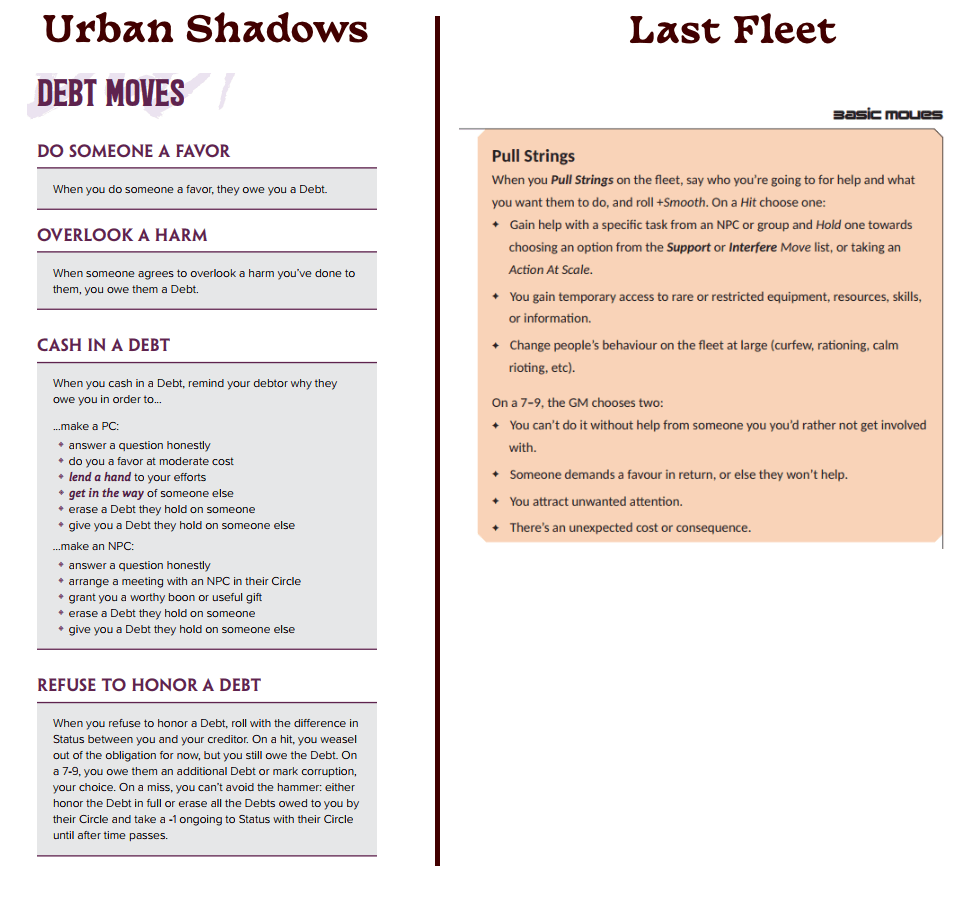
In Urban Shadows, debt is a primary pillar of play. It’s the heart of the social and political game. You gain a Debt on someone when you do them a favour or overlook harm they did to you. (And they gain a Debt on you if they do you a favour, etc). You can spend that Debt to make them do a favour for you and some other stuff. This is essential because the game doesn’t have anything automatically uniting the players. The characters are not the same party or crew and probably don’t have the same goals. Without something pulling them towards each, you’ll end up with a game where everyone is just playing in parallel tracks.
Now the tough part: I don’t like Debt. And as we play the game, I can’t help but think about other games that tackled this problem differently. Like Last Fleet, which I wrote about here. But whether I like it or not, there’s something interesting happening here.
The key detail about Urban Shadows is that debt is a currency. Now, that is a technical game design term for anything you track and spend. But here it’s true in a deeper sense. The model for how Urban Shadows thinks about debt is basically currency. Debt is something to be accumulated and spent, to be traded and consolidated and leveraged for power. You’re supposed to be thinking about debt. You’re supposed to be earning it and exploiting it.
To go back to Last Fleet, there is no currency there. There is an exchange but it is immediate and personal. Two people need help and so they help each other. It’s transactional but it’s not abstracted away. It’s not transformed into something transferable. There is no book-keeping in Last Fleet, both literally and figuratively. Urban Shadows is about the book-keeping – everyone’s an accountant with a ledger showing how much power they have.
And my problem with being a sociopathic bean-counter is not with the sociopath part (that comes naturally to me), it’s the part about counting beans.
The symbolic or metaphorical resonance of debts is strong. Everyone’s caught in the teeth of the debt economy. But at the same time, it’s so fragile. A debt isn’t a big deal. You can cash it in for a moderate favour. What’s a moderate favour? It’s not clear. But it’s definitely not a big favour. You can start with 3 debt on someone. That sounds like a lot. But I’m not sure if it is.
Also, you can just refuse to honour a debt if you want. Really. It’s fine. The worst that happens is you lose debts from other people. But if you’re the kind of person who refuses debts, you’re probably not amassing them in the first place. So you can technically just opt out of the debt system and still be powerful and cool. Welp, there’s the teeth of that metaphor gone now.
If I’m going to be a sociopathic bean-counter, the beans better be worth it.
Yours, trained as an accountant actually,
Thomas
II. Media of the Week
- Funny 4 minute animated video from Zee Bashew titled Discourse.
- On Yes Indie’d, I speak to Aaron Voigt, youtuber and game designer, about his forthcoming novel and game of the same name, Detente for the Ravenous. We talk about writing novels, designing games based on them, and exploring religious themes in your work.
- Shout out to new patron, Craig! You too can support the newsletter on patreon!
- If you’ve released a new game on itch.io this month, let me know through this form so I can potentially include it in the end of the month round-up.
III. Links of the Week
Articles/Essays
- In the Los Angeles Review of Books, an essay on Vermis: “As a strategy guide to a fictional video game, Plastiboo’s work in Vermis finds its closest analogues not among the coffee table art books lining the Games shelves of big-box bookstores but among experimental fiction, especially of that rare form which presents itself as secondary literature to nonexistent priors: catalogs and critiques of fictional literatures, of which the best known are perhaps Stanisław Lem’s A Perfect Vacuum (1971) and Roberto Bolaño’s Nazi Literature in the Americas (1996).”
- A review of WM Akers’ Deadball, an RPG about baseball: “One of the things that struck me reading Deadball was its sense of reverence for the sport. Its language isn’t flowery. It’s plain and technical and smart. But its love for baseball radiates off of the pages. Not like a blind adoration. But like when a dog sits with you on the porch.”
- On Rascal News, Nima Dabirian writes well about playing RPGs in Iran: “I came into Iran’s D&D community with a Western perspective. I learned about the game from American actual play shows, and I thought that professional and performative experience was what I would get.” (Paywalled)
- On Playful Void, eight tips on editing your game manuscript, primarily about information design.
- JARPS, the academic journal, has a short paper on the history of gamebooks in Japan.
- Burn After Reading writes about His Majesty The Worm, Trophy, and Perilous Wilds in a nice post about doing dungeoneering differently.
News/Misc
- Chaosium have been harnessing the nostalgia and love for classic games with a series of campaigns to bring back first editions of their games in luxury formats. After Call of Cthulhu and Runequest, it is the turn of Elfquest’s first edition from 1984.
- TinyCon, a website to organize RPG conventions, is crowdfunding.
- After the Hasbro announcement on AI, Kobold Press came out strongly against using AI in their work.
- Roll20Con have two bundles for Doctors without Borders featuring games like Dragonbane and Night’s Black Agents.
- There’s also a bundle on itch raising money for the DOTS project to boost accessibility in games.
- Yohai Gal has released the source code for Kettlewright, a digital app for his game, Cairn, that does character creation among other things.
From the archive:
- A crowdsourced spredsheet of larps you can play online (Issue 51, August 2021)
- Age of Ravens publishes 72 complications for sci-fi heists: “Psychic Android Doppelgangers: Robotic defense systems designed to take a mental snapshot of an intruder and then shift their appearance to match them. They’re designed to infiltrate a team, causing dissention and dividing their attention—while at the same time gathering information. Localized comm jammers allow them to isolate members.” (Issue 51, August 2021)
IV. Small Ads
All links in the newsletter are completely based on my own interest. But to help support my work, this section contains sponsored links and advertisements. If you’d like your products to appear here, read the submission form.
- MONSTER GUTS is a LUMEN game inspired by our favorite monster-hunting videogames, and it’s crowdfunding a print run and expansive second edition! Click here to learn more!
- Need a break from it all? Blast off into the stars with your mech best friend ✨Chill out and relax in ION Heart, a lo-fi solo sci-fi TTRPG from the award winning creators at Parable Games. 🚀 Late Pledge on Backerkit here.
- Do you want to believe? 🛸 Join a secret organisation, fight a war against unseen threats to humanity, learn everything reveal nothing 🔍 SHIVER Classified, a conspiracy TTRPG launching soon. Try the demo on Backerkit here.
- The Town Where Nothing Goes Wrong: a combat light, hilarity heavy one-shot! Packed with rom-com tropes, and a time-loop twist. Can your players save the wedding and escape? Back now
This newsletter is sponsored by the the wonderful Bundle of Holding.
- Baker Street, an alternate timeline where Sherlock Holmes goes missing and you solve cases.
- Shadows Over Sol, a hard SF action-horror RPG
Hello, dear readers. This newsletter is written by me, Thomas Manuel. If you’d like to support this newsletter, share it with a friend or buy one of my games from my itch store. If you’d like to say something to me, you can reply to this email or click below!


Leave a Reply