I. Dear Reader,
What do you see when you look at a game? When we talk about visual art like a painting, we look it and we see line, colour, composition, pattern and so on. And we could talk about that stuff when we talk about games but then we’d be talking about a book’s graphic design. Which is important but there are better people to do that – better eyes to see through.
Normally, when I talk about games and art, I’m drawn to what you can’t see: what play feels like, the design lineage, the artistic statement, the political and social context in which it is made, etc. But I’m asking myself something different now: if there is a game in that book, what do I see when I look at that game?
Games do have a form. When we talk about Apocalypse World as innovative, one of the big things we are talking about is an innovation in form. It was the form of a work-in-progress Apocalypse World that caught the attention of a series of game designers in 2009-2010 – so much so that Apocalypse World 1st edition could’ve lost the race to be the first PbtA game to be published. It is this innovation in form – the form we see in those early offspring like Monsterhearts, Monster of the Week, Dungeon World – that most people think about when they think PbtA.
What is this form? Well, it’s stuff like how a move is written (its shape?) and what the Bakers refer to as the structure of the game, including stuff like agenda, principles, GM moves, the conversation, etc. The image from Vincent Baker’s post here captures the big picture.
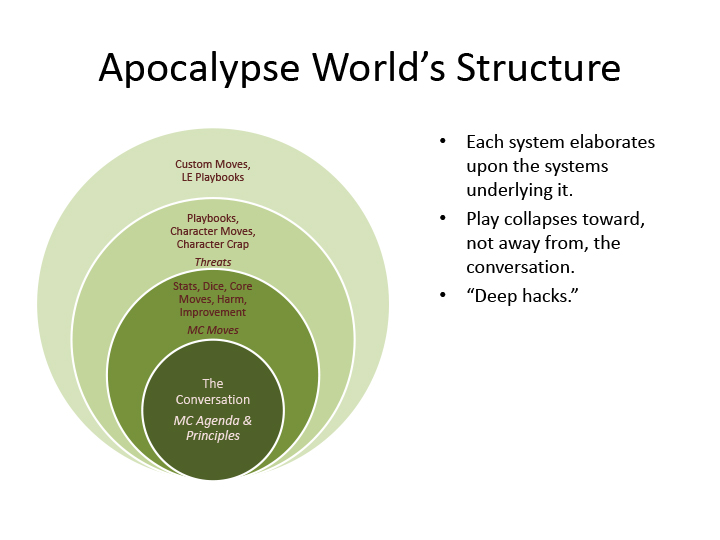
The form of Apocalypse World is different from the form of the trad games that inspired it, like Ars Magica – even as the actual playing of both of those games (depending on whose playing it) could be the same. Or to put it another way, people (including the Bakers probably) were playing games in the style of AW before AW existed. The innovation wasn’t in the outcome, it was in the form.
Did that innovation in form lead to the spread of a culture of play that people now think of as the PbtA style? I think so! But that’s the power of form, right? The design of AW made an obscured style much more visible and accessible.
You know which game didn’t necessarily innovate in form? Blades in the Dark. Controversial? Not my goal! For me, part of the appeal of Blades in the Dark is that it actually looks like older games like Vampire the Masquerade (at least more than AW does). Obviously, Blades in the Dark is innovative (in form and other ways) but parts of it look so familiar that it actually feels more approachable than PbtA to people who have played other trad games. You have what look like skills and you roll them. Easy. We could play right now.
(How much of Apocalypse World‘s popularity can be attributed to what it didn’t change? You know, XP, damage, gear, classes, etc. How much of Blades in the Dark‘s popularity is due to its familiar guise? The psychology of novelty and familiarity is fascinating but I won’t get into it because I am completely ignorant on the subject and maybe that is for the best.)
I hope I’m not unnecessarily complicating things by using the word “form” to refer to a part of a game’s design. I think if I said For The Queen or Yazeba’s Bed and Breakfast were innovative in form, it would be more clear because I’d be talking about the game’s physical look. But Apocalyse World just looks like a book, right? The reason I’m using the word is that there is a difference between the innovative stuff that AW does design-wise (safety-first asymmetric PvP, for example) and its innovations in form. And it would be good to look at them separately and see that divide.
Also, I think it helps us understand what parts of the game we’re talking about when we discuss a game without playing it. All in the quest of being to articulate what we see when look at a game.
Yours, having read one book on art,
Thomas
PS. It’s been a couple of dry weeks for the newsletter so glad to be writing again. I’m not an art historian but I was inspired by my conversation with Huffa (who is one) on the Yes Indie’d podcast to think like one.
PS2: I know “safety-first asymmetric PvP” could potentially sound like I’m casting some kind of gibberish spell. If you haven’t played AW, this explains a part of it.
II. Media of the Week
- Dice Exploder had some good episodes recently. Aaron King was on to talk about Love Letters, which is a very niche but very useful technique to have in your backpocket regardless of your style of play. Caro Asercion talked about a larp called Keymaster, which was a conversation about creative potential as much as anything.
- Shout out and thanks to my patrons, Nikolas, Amy and Julianna! If you’d like to join them and 100 other people to support this newsletter, check out the patreon!
- If you’ve released a new game on itch.io this month, let me know through this form so I can potentially include it in the end of the month round-up.
III. Links of the Week
- Ben L of Mazirian’s Garden does a good job of explaining good lore and bad lore: “Bad lore is irrelevant to play; and for this reason boring; and for this reason hard to remember; and for this reason doesn’t deepen the sense of inhabiting a shared world.”
- On Skeleton Code Machine, a review of The Locked Room Murder Mystery Game, where you construct a mystery and its solution together.
- Rascal News returned from break and had a good week: this is a nice post about Hasbro’s AI hype and one about the struggles of the Gloomhaven RPG project.
- Via Wyrd Science, an interesting post about the very weird right-wing fantasy from 1986, The Price of Freedom: “I used to believe that it would be impossible to use roleplaying games for the purposes of political propaganda. Players had too much agency, too many opportunities to subvert the message. I no longer believe this.)”
- Not RPGs but I enjoyed this post about what it means to be a billionaire in Neopets: I had not yet learned the word “capitalism” when I started playing Neopets, but I had already become a neoliberal—a Neo-liberal, if you will.”
From the archive:
- Zedeck Siew reviews a game by Gregor Vuga (Sagas of the Icelander) and talks about Warhammer as an inspiration and burden: “I think Kriegsmesser surprised me because its framing of Chaos — as a promise, as the light of hope shining through cracks of a broken world — It feels so fucking right.” (Issue 50, July 2021)
IV. Small Ads
All links in the newsletter are completely based on my own interest. But to help support my work, this section contains sponsored links and advertisements. If you’d like your products to appear here, read the submission form.
- FREE QUICKSTART: Totem, a Rules-light Narrative Horror RPG inspired by Ghost Story Masterpieces such as Shining, Poltergeits or Silent Hill! Will you play a friendly ghost or an insidious demon?
- Enroll in a cursed magical school that contains even more horrors than before. Tangled Blessings: Echoes of Lost Electives is crowdfunding now. GM-less. 1-2 players. Pledge here!
- Uncover the darkness in SHIVER Classified 🔎 Create your own special agent and delve into terrifying mysteries in this secret conspiracy TTRPG 🤫 Try the demo on Backerkit here.
This newsletter is sponsored by the the wonderful Bundle of Holding.
- There’s a bundle of Root, the RPG based on the boardgame of woodland warfare.
- Also, there’s two bundles of Advanced 5e from the ENWorld folks: one with the core system and a new one with adventures.
Hello, dear readers. This newsletter is written by me, Thomas Manuel. If you’d like to support this newsletter, share it with a friend or buy one of my games from my itch store. If you’d like to say something to me, you can reply to this email or click below!


 Indie RPG Newsletter
Leave a reply to pkhill44fa2e7978 Cancel reply