#132: Axes of Game Design

more theory than anyone should be legally allowed to possess

I. Dear Reader,

All the way back in Issue #69, I linked to a series of episodes from the Ken and Robin Talk About Stuff podcast about the “axes of game design”. I’ve been thinking about them again recently and thought it might be interesting to look at each one. I’ll be referring to the summary on the Pelgrane Press blog as I comment on them.

So the basic exercise is trying to figure out the standard axes or spectrums on which every game can fit. The idea is for these axes to be as descriptive and objective as possible. While there is always going to be debate around the classification of specific games, the idea is that in a perfect world with perfect communication, that debate would have a truly correct answer. We don’t live in a perfect world but I’m happy to discuss things like this forever.

So here we go:

  1. Elegance versus Ornamentation

A game has Elegance if all of its subsystems work in the same way, stemming from a central resolution mechanic, or is Ornamented if its many subsystems work in different ways

So the first axis is one of the strongest and makes a great example of the level of objectivity we can hope to achieve here. In some sense, the degree to which a game falls back on a single unified mechanic should be clear and measurable. At the same time, it’s not any indication of how “good” a game is. One-page games are highly elegant but they’re by no means “better” than longer games.
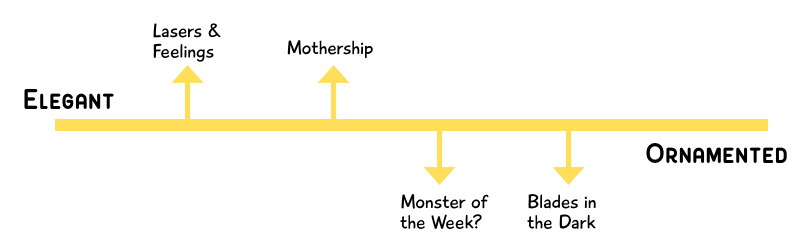
One thing that’s interesting is to see where PbtA falls on this spectrum. A game like Monster of the Week is pretty elegant because everything is essentially 2d6+stat. But does the number of moves, especially moves like Big Magic where you negotiate the effects of a spell or ritual, push it toward being more ornamentated?

  1. Wide versus Focused

A game has Width if it supports play equally well over a long progression of power levels, or Focus if it works best at a narrower sweet spot.

I think this is where it’s probably best to start moving away from Hite and Laws’ wording. I think terms like “power level” is a wargame hangover. I think this is better phrased as “kinds of characters”. A game that is Wide is designed for a many kinds of characters. A game that is Focused is designed for specific characters or types of characters.

So you get something like Lady Blackbird (which has a cast of named characters on one side) as Focused and Risus (which is as generic as it gets in terms of character creation) as Wide. And yes, I put D&D 5e in there because I revel in the symphony of a hundred angry keyboards click-clacking away.

  1. Directed Emotion versus Emergent Emotion

A game can have Directed Emotion, stemming from rules that lead you to feel a certain way, or Emergent Emotion, in which the reactions of players and GMs stem from the story content they introduce.

This phrasing is a little clunky because in their discussion, Hite and Laws felt that something like “Emotional versus Detached” was uncharitable. And I understand. But I also think that “Directed versus Emergent” is a bit like saying “Designed versus Undesigned”. I think the premise of the exercise that is “undesigned” isn’t a thing. If we want to describe a game as “neutral” on some axes, it should ideally fall somewhere in the middle. So I propose Hot versus Cool. Hot games try to stoke up emotions in the players. Cool games try to cultivate an air of cool, ironic detachment. They don’t want you to feel too strongly about the events of the game.
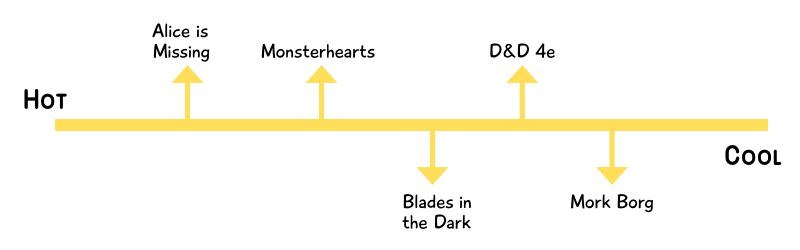
(The original article also mentions “Abstract rules for their mathematical or formal attributes, or Emotional rules when they grow out of the feelings they are meant to evoke at the table.” but this feels like it overlaps heavily with this point now.)

  1. Applicability versus Versatility

A game has high Applicability if it is designed for a single highly specific player character core activity, or Versatility if it supports many possible core activities.

This is just Wide versus Focused for mechanics rather than characters. On one hand, they’re separate things. On the other hand, it’s clearly related. It’s a bit hard to imagine how a game might support wide characters with focused mechanics or focused characters but with wide mechanics, right?

  1. Simulation versus Emulation

Games that focus on Simulation resolve events as they would unfold in a causal reality, or engage in Emulation, so that events unfold as they would in a movie or book, to keep the narrative running in a satisfying manner.

I’m not quite sure about this one. I’m struggling to understand which games commit to simulating real world physics. What’s the game on that end of the spectrum? I know OSR games revolve around the GM arbitrating physics impartially but in a game where dragons exist, how seriously do I take that claim? They would probably be in the middle of this axis at best if you ask me.

  1. Ease versus Mastery

A game favors Ease when players can pick it up and run with it right away, or Mastery if it presents complex or elaborate rules or setting material, favoring those who take the time and brainspace to learn it.

For me, the important thing to ask ourselves here is whether the word “player” includes GMs. If it does, all rules-light games that might seen to favour Ease are not so easy anymore. (Which reminds me that I never actually talked about “affordances” as a design concept – an article for another day.) If we limit ourselves to “player facing mechanics”, then yes, I can see the spectrum. The problem is, of course, it looks exactly like my Elegant versus Ornamented spectrum.

What kind of games are Ornamented but don’t reward Mastery? What kind of games are Elegant but don’t favour Ease?

(The original article also uses the Harmonica vs Violin with Harmonicas being simple to play and Violins requiring more work. I think the overlap here is high.)

  1. Canon versus Open

When it comes to setting, a game oriented around Canon presents a detailed setting with a set continuity meant to instill the same suspension of disbelief we apply to SF and fantasy worlds in traditional media. Open settings arise from the authorship of GM and/or players, with plenty of room to make stuff up as you go along.

This seems really clear. And I think examples might be unnecessary.

  1. Randomness versus Choice

A game or system dependent on Randomness uses die results to work out what happens. A game that privileges Choice has players and GMs decide.

This also seems clear. Some games don’t give players the power to just choose what happens next. Some games push players to decide when they want spend resources to just make a specific thing happen.
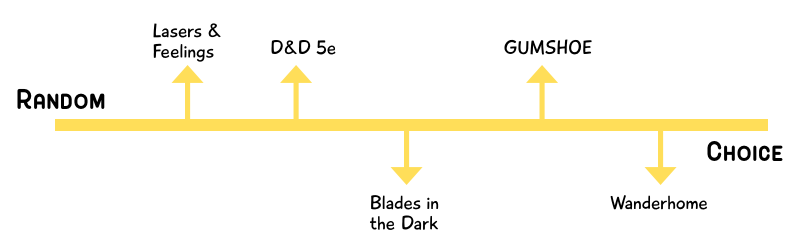
This was a really interesting exercise for me. Lots of open questions that I’m excited to engage in nerdy conversations about. And just to be clear, Laws and Hite know what they’re doing. I have a great respect for their work. I just wanted a place to start building out on their ideas.

For further reading, check out this post about game design on two axes: player-driven versus GM-driven, prepped versus improvised.

Yours on multiple axes,

Thomas


  • We hit 3000 subscribers and I forgot to celebrate so I’m taking the chance now. Thanks for reading, folks! I appreciate having an audience – it’s a gift and I’m grateful for it.

    Subscribe now

  • Also, next week, I’ll do the monthly roundup of games on Itch. If you’ve released a new game on itch.io this month, let me know through this form so I can potentially include it.

  • And as always, if you can support the Indie RPG Newsletter patreon. That would be grand!


II. Media of the Week

Vampire cowboys!


III. Links of the Week

  • On Gizmodo, 30 games for heists, burglaries and bank jobs

  • On the Indie Game Reading Club, a written example for how conversations should work in Forged in the Dark games.

  • Judd Karlman outlines a campaign for idea for a group of mercenaries hired to defend a city.

  • Prompted by Here We Used To Fly, a nice exploration of “pure storygames”.

  • The new Soloist newsletter has an intro to solo games as their first post and it includes some suggestions from me.

  • If you’ve played Bite Marks, inventing werewolf slang is such a fun way to start. And on the ars ludi blog, there’s some nice advice on inventing new words.

  • The Global South Shoutout is a cool newsletter that shares designers from the Global South. This edition is about Forgotten Ballad, an OSR/NSR game by Brazilian designer Fellipe da Silva.

  • Some really interesting advice on running Call of Cthulhu 7e: “During the Bout of Madness, you should never, ever, ever, ever write anything internal to the psychology of the character. You should always, always always, write something external to the character.”

  • Paul Czege does an AMA on reddit talking about his new zine as well as games like My Life With Master and The Clay That Woke.

  • On Age of Ravens, a new mystery for Apocalypse Keys: people in Barcelona are getting stolen away to magical realms!

Zine Month


IV. Small Ads

All links in the newsletter are completely based on my own interest. But to help support my work, this section contains sponsored links and advertisements. If you’d like your products to appear here, read the submission form.

  • Beneath Hallowed Halls is a Powered by the Apocalypse/Dark Academia TTRPG of friendships that run deep and bodies that are buried even deeper for #ZineQuest23.

  • These Stars Will Guide You Home is an Odyssey-inspired solo journaling rpg about an epic voyage looking for home in a mysterious archipelago.

  • Strikes & Spares is a slice-of-life tabletop roleplaying game with a slightly hard-luck/offbeat tone that’s set in a small-town bowling league. You can find the Kickstarter here!

  • The Connection Machine is a science fiction RPG about attachment, trauma and the search for meaningful connection. Explore a dream-like world to create stories about hope, grief, shame, freedom, attachment and love.

This newsletter is currently sponsored by the Bundle of Holding.


Hello, dear readers. This newsletter is written by me, Thomas Manuel. If you’d like to support this newsletter, share it with a friend or buy one of my games from my itch store. If you’d like to say something to me, you can reply to this email or click below!

19 responses to “#132: Axes of Game Design”

  1. YourDie Avatar
    YourDie

    In procedural generation of stories on digital games there is a similar axis to “Simulation versus Emulation” which feels very similar to how the quote describes it.
    A procedural generation system that is more on the Simulation side of the axis will let characters act out on their motivations and beliefs, with little regard of whether that results in an engaging story.
    In contrast, a system that favors emulation is reasoning about dramatic tension and story beats, and will try steer characters in a direction that will create a compelling narrative, preferably with a nice conclusion.

    Taking that back to TTRPG systems, I would interpret a simulation game a game where players predominantly make decisions from the point of view of their characters, while an emulation game lets players make decisions from the point of view of the storyteller, like Microscope.

    Like

    1. Hoist Avatar
      Hoist

      hmm yes you might have something there although i think the last paragraph could be better stated, pov from the character doesnt mean much to me so some clarification there perhaps, i think that always factor in and pov from storyteller could be pov from the story instead.

      So here is my take based on what you wrote:

      Decisions made from the POV of what the character knows (only act on what the character knows in game to serve ?immersion?(immersion can be had either way i think maybe something like identification with the character or character bleed is better but you can have that on the other side of the scale as well, hard to pin down what this POV serves, maybe its just YOU vs STORY))
      vs
      Decisions made from the POV of the story (freely incorporate ooc knowledge, genre tropes etc to serve the story better)(and yes this is where storytellers usually exist on this axis do but they are players to so i would not say that its a storyteller thing specifically)

      Like

  2. StoryShtick Avatar
    StoryShtick

    I love your Hot vs Cool axis! I think it defines something that has bothered me since I started running Story Games. I don’t know if this was part of what you had in mind, but it works for me.

    Most role-players are D&D players (and DMs). Therefore, they likely have only experienced the Cool-er side of RPGs (I think this applies equally to World of Darkness players, maybe more so). Speaking in-character at a D&D table may be good or iffy depending on the group, but getting Hot is usually discouraged. I once had my character make a stand at a bridge that resulted in his death. I thought it was a cool way to go, but his decision was clearly hot. The other players were actually distressed when my character died and tried to come up with all the ways to bring him back or otherwise change the outcome. Character death in D&D is NOT COOL, even in a heroic sacrifice that is very much a part of the fantasy genre D&D is rooted in.

    So when you try to get D&D players to try a Hot game, something centered around emotional stakes and character death/ruin like Fiasco (also, poor impulse control is very uncool), they are often out of their element. I used to think it was because most D&D players aren’t interested in actually, you know, role-playing, but that was probably unfair. They are just on the Cool end of the spectrum and weren’t ready for the shock of diving into the Hot tub. I think the reverse is true for me because I haven’t been able to go back to D&D – that water is too Cool and I’m staying in the Hot tub until I prune! Whereas lots of gamers will happily go back and forth for quick dips in each.

    From what I’ve seen, DMs/GMs are usually more adaptable. They spend a lot of game time portraying very emotional and uncool NPCs for the cool PCs to react to. For players, maybe more could enjoy Hot RPGs if this important difference were explained to them up front? There will always be naturally cool players that don’t want any emotional risk to their characters (they mostly play bounty hunters, necromancers, and vampires) just like there will always be Hot players like a friend of mine that played the Battlestar Galactica board game in character (only the Cylons at the table were pleased).

    Anyway, I didn’t have the right words for this before, so thank you very much! I think this could be very helpful to me (and others) in the future. I look forward to you future posts on this topic!

    Like

    1. Thomas M Avatar
      Thomas M

      Hell yeah! This is exactly the kind of response I hoped to get. Glad it click for you. I think D&D is a great example of a game that some people want to play as Hot but it really – at least the tactical combat – is very Cool by default. But yeah, it’s great that you figured out what kind of games you like best. I feel like that’s what we all really want to do.

      Like

  3. metaphysiocrat Avatar
    metaphysiocrat

    For sim vs em, if you’re getting tripped up by words like “simulation” or “realism,” you might benefit from reconceiving the axis as “internalist” vs “externalist” or as “Watsonian” vs “Doyelsian.”

    Eg, who would win, the Enterprise or the Death Star?

    Internalist/Watsonian: “The Death Star is able to dock many Star Destroyers, each of which as capital ships seem roughly equivalent to the Enterprise, so the Death Star would win” or “the Enterprise can target torpedos in a way that we know can destroy the Death Star, so the Enterprise would win”

    Externalist/Doyelsian: “The Enterprise are the good guys so they would win” or “we’re imagining this at the end of the second act, so we’ll have the Death Star win to build tension”

    Note that an internalist might bring up complicated mathematical arguments (I’m sure they have on this exact question many times) but as in the above they don’t really need to.

    “Neither, because the Death Star and Enterprise don’t really exist” obviously isn’t an ultra-internalist position but instead a rejection of the premise entirely. (Which is fine – maybe you want to talk about politics or basketball instead.)

    YourDie has brought up what simulationism or internalism looks like from a player perspective and your comment on OSR neutral refereeing describes what this looks like from a GM perspective. (For some especially lucid writing on the latter I recommend Sandra from idiondrotting on “blorb principles” and “three tiers of truth.”) Note that these don’t have to align… What John Bell calls “trad” or what I think of as “high 90s illusionism” involves players immersing themselves in the viewpoint of their PCs while the GM manipulates things behind the scenes to produce a satisfying narrative.

    Final thought, maybe obvious – a lot of these are often really more manifested by play procedure than by rules “as designed,” especially for less focused games. Basically nothing in the D&D 5e rules dictates on the player side that you view your character as a story character vs viewpoint avatar vs game pawn, and on the DM side you have basically the same flexibility in terms of what requires a skill check and what the DCs are (which is basically the whole system, at least outside of combat.)

    Like

    1. Thomas M Avatar
      Thomas M

      Thank you so much! This was really insightful and explained it very clearly!

      Like

    2. Kaleon Avatar
      Kaleon

      I think an additional thing to think about is the term “causal”. Many people take that to mean “realistic” but it doesn’t have to. Causal simply means the reality of the game begets the traits of the game. This actually dovetails nicely into Externalist/Internalist. A causal game (or a simulation) puts the rules first and the reality of the setting as the basis for those rules (even though they may be unreal such as dragons) and puts a certain amount of effort into forcing players to act within those rules. An emulation, on the other hand, focuses on story and narrative and allows those “rules of reality” to be a bit squishy.

      This is one reason why I think Mage the Ascension was often so hard to integrate into the other WoD games, because it was much more emulation compared to the simulation of the other product lines.

      My .02$

      Like

  4. Hoist Avatar
    Hoist

    ease – mastery vs elegant – ornamented

    While in general as you say they are similar i think in many cases elegant games can require higher mastery as they can be hard to play “right” and this i think is also related to the cool – hot axis or the simulation – emulation axis
    E.g. a player that has played very cool games and then switches to a game that is hot might play the hot game in a cool way and not get 100% out of the hot game and will be confused as to what the point is of some mechanics are etc
    A game that on the surface looks like it would be a game towards the ease part of the spectrum can thus be considered as something that requires mastery by some people depending on past experience.

    I think for ease vs mastery to make sense one need to define to whom the question is posed, someone who has never played roleplaying games, someone who has only player hot or cold games, someone who has experience with both hot and cold games, someone who has only played simulation or emulation games, someone who has played both simulation and emulation games.
    And to be charitable we will assume that said person does not have dislike for any particular part of any axis.

    or maybe these axis only makes sense when using them on yourself or in a smaller conversation not on a broader scale where its easier to calibrate and understand what you mean, a tool to be used in specific circumstances?

    Like

    1. Oliver Avatar
      Oliver

      Yeah, I think it’s more complex than “fewer rules = more elegant and easier to play.” For instance, I find it really difficult to get a satisfying experience out of games with very little structure, like Fiasco or The Quiet Year. Games with more rules can offer valuable guidance for those of us who aren’t so practiced at crafting stories out of thin air.

      IMO, that’s the beauty of the Bakers’ rollercoaster philosophy of design. (#3 on this page https://lumpley.games/2019/12/30/powered-by-the-apocalypse-part-1/)

      And this might be nitpicky, but I also think “elegant” isn’t a great choice for “fewer rules,” since people often use “elegant” to just mean “well designed.” Like, Masks isn’t rules-lite, but I’d still call it one of the most elegant games I’ve played. The mechanics are so clear, approachable, and evocative of the source material, and every system fits together so neatly; it all makes such intuitive sense. With first-time players, I don’t even ask them to read the rules in advance. They can just show up, grab a playbook that looks interesting, and I’m confident they’ll pick it up as we go. That is some elegant-ass design. 😀

      Like

      1. Susan Beneville Avatar
        Susan Beneville

        I totally agree. I use “elegant” to describe Numenera/Cypher, but I wouldn’t call them rules-lite.

        Like

  5. Chris Sellers Avatar
    Chris Sellers

    What a great article! I think Wide vs Focused as they originally proposed it is more about character progression, i.e., the way that D&D and DCC get more fun after you’ve advanced a few levels and the game gets less deadly for PCs. BRP is also like this, or any “zero to hero” game … I associate this tendency more with trad games. D&D might even get less fun when you get too high in levels, when it’s hard to find a worthy threat. PbtA games are fun early in the character’s progression, but if you advance enough to make all your stats at least +2, you mostly stop rolling misses, and the mechanics of some PbtA games can break down. I know there are a lot of PbtA and BoB games that have very shallow progression arcs and so avoid this issue … and Night Witches, for example, balances its upward progression with a brutal progression of scars … I’m sure there are plenty of others, and I’m just blanking on them. Having said all that, I like the spectrum you’ve made of games that work better for specific characters vs a wide array of character types; it’s fascinating how it isn’t necessarily dependent on how long-term the game is designed to be played. I’m going to use this whole article to help me find more games to play!

    Like

    1. Susan Beneville Avatar
      Susan Beneville

      Good point! I think this applies equally well to the Randomness/Choice axis. In PbtA’s and FitD games like Blades in the Dark, as you progress you move steadily more into the Choice-side. This is especially true where you can pretty much avoid any harm and always dictate which ability you are using (in Blades, especially).

      Like

  6. Geoffrey Golden Avatar
    Geoffrey Golden

    Congratulations on hitting 3K, Thomas! As a long time reader, it’s exciting to watch how your newsletter has grown.

    Like

    1. Thomas M Avatar
      Thomas M

      Thank you, Geoffrey!

      Like

  7. RJ Avatar
    RJ

    For simulation vs. emulation, think of Batman fighting the Joker. Does the game make an honest appraisal of their fighting ability and the likely results? Or does the fight progress as a series of beats, in which the drama of the fight is resolved in a comic book like fashion?

    Like

    1. Kaleon Avatar
      Kaleon

      This is a very streamlined version of what I mentioned above and wish I’d read this before posting. Very elegantly said. Simulation is placing the rules of your reality first, while emulation is placing the story you are telling first.

      Like

  8. Susan Beneville Avatar
    Susan Beneville

    I have never played a “hotter” game than Blades in the Dark. This is partly because my RPG group is very comfortable with “emotional” roleplay. But, also the mechanics drive play in that direction. Individual XP is awarded for playing consistently with your character’s beliefs, drives, etc, or for struggling with your vices or traumas. The ultimate harms are literally traumas. Similarly, the fact that playing as a Crew is central, means that group dynamics are front and center. Which of course is rewarded when you “express the goals, drives, inner conflicts and essential nature of the crew.”

    Like

  9. Teigills corner Avatar
    Teigills corner

    Thanks for posting! And congratulations on 3000+ subscribers. Do you know of any sources that talk about game design axes like these and player types like Bartle’s taxonomy?

    Like

  10. The Answer Is Always Both – Indie RPG Newsletter Avatar

    […] RPGs” for literally the last five years. I have multiple starting points. My post about the Axes of Game Design is already a kind of aesthetic framework for talking about games. Levi Kornelsen’s Praxic […]

    Like

Leave a reply to Chris Sellers Cancel reply