I. Dear Reader,
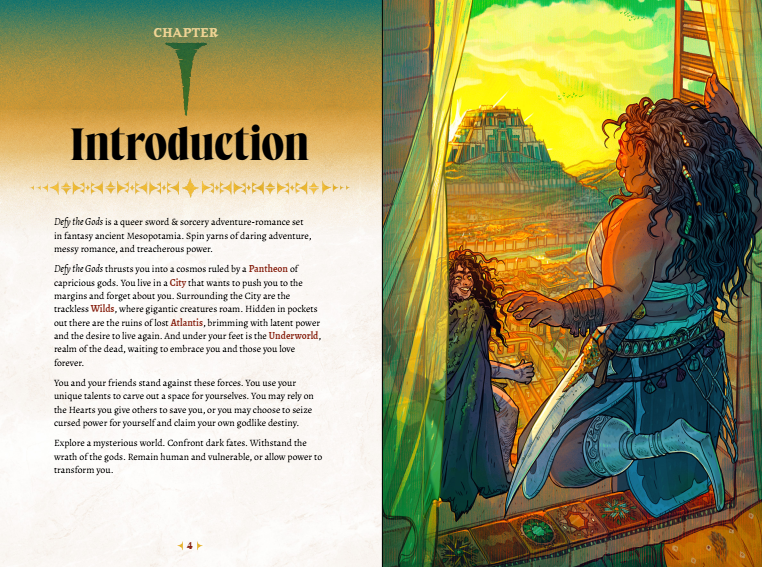
I’m running Defy the Gods, a queer sword and sorcery PbtA game, by Chrys Sellers. I liked the look of the quickstart and I needed a specific kind of game. Back in May, I wrote about how I ended my Apocalypse World: Burned Over game by skipping past the part where the players would’ve killed the gods and changed the world. It remains one of the coolest things I’ve done at the table.
The plan was to pick up the game in the changed world and discover retrospectively how the players’ characters did what they did. This new world was going to be a green fantasy and I was initially thinking about feelings-fantasy game, Ryne, but the PDF wasn’t out yet. (It has since come out to backers, I believe.) So I chose Defy the Gods instead even though I normally wouldn’t run a campaign from a quickstart.
The game was delayed (obviously) but five months later (oops), we’re hitting our stride in session 3. We had a bunch of starting issues early on. When I ran AW, I started each character with solo scenes so the players could kick the tires on the character a little bit by talking to some NPCs. It always works well. I thought I did the same in Defy the Gods but I just framed the wrong scenes. What do I mean by that? In AW, the scenes were with key NPCs and contexts that defined the characters. The leader of the biker-gang was with his biker-gang. The town leader was in holding court with her advisor, etc. In my Defy the Gods game, I framed scenes that was about the day-to-day life of the characters but it didn’t work. After that, the players still had no idea who they were really. I think I got carried away with it being “an adventure game” and was rushing them towards the adventure!
They brought it up in the next session and so instead, we did character defining solo scenes, which were (for 2 out of 3 characters) flashbacks to backstory moments that defined them. We did a scene about how the sailor got his ship in a bet, and so on.
In session 3, we solved another problem. I say “we” but the cool part about it is how the player and the rules worked together to solve their own problem and I had nothing to do with it. So I mentioned the sailor. They’re a playbook and their whole deal is that they’re a romantic swashbuckler. It’s not got a lot more happening than that and the player was feeling it. The other characters felt… deeper? More conflicted? They had stuff going on that they were wrestling with! The sailor was trying to figure out how to get some of that juicy drama for himself.
In the middle of the game, he rolled too well on a move (this is one of those games where if you roll too high, you can succeed too much and things can go awry, like Apocalypse Keys). They were trying to shut down a thousand year old sentient machine that was losing coherence. The game calls this stuff “Atlantean artifacts” but they’re basically pre-apocalypse tech and it was doubly cool for us because we had invented the pre-apocalypse civilization in a Microscope game. Anyway, the player was trying to do a nice thing — a gentle thing, asking it to quietly into the night rather than hang on in a world that had changed around it.

But he rolled too high and the move (called Beseech a Force) told him that while he might’ve started with good intentions, he now grasps for too much power and acts monstrously. So my player thinks for a bit and basically tells the machine that it can be free and shut down but it should download every thing it knows into his brain so nothing is lost. The human brain isn’t built to contain the memories and thoughts of a thousand year old sentient construct. But now that’s exactly what’s happening. The machine “downloads” its consciousness into the sailor and now he has this other (very damaged) person riding along in his mind now. That’s taking internal conflict pretty literally if you ask me! But hey, whatever gets the job done! And like I said, the cool part was that the player and the rules did that between themselves. I just had to say yes.
And that’s pretty easy.
Yours, doing nothing,
Thomas
II. Media of the Week
- Over on Yes Indie’d, I speak to Elizabeth Little, designer of You Will Die In This Place. It’s described as “a nihilistic dungeoncrawler about art, death and identity”. It’s weird, meta, layered (think House of Leaves) and has cool asymmetrical class design. We talk about its design and themes (everything is a labyrinth! relationships, language, art, mental illness, everything!)
- My primary online gaming community, Open Hearth, has a podcast episode explaining what it is and how it works.
- Also, a cool video from Weird Place, about sports TTRPGs.
- Actually, here’s another video. This one is from Blerdy Disposition and showcases some cool one-page RPGs from the 2025 game jam.
- You too can support the newsletter on patreon!
- If you’ve released a new game on itch.io this month, let me know through this form so I can potentially include it in the end of the month round-up.
III. Links of the Week
- Kotaku has a great piece with Sam Reich about essentially being a game designer on Game Changer: “I think my competence as a game designer has sort of grown as the show has grown and the budget has grown. So if you start Game Changer from the beginning, you can kind of watch my journey as a game designer, which I think is fun.”
- On Hendrik Biweekly, there was a heavy-lift introductory essay on thinking about game design using product design language. Basically, the language of “affordances”. It breaks down how product design does demands, refusals, requests, encouragements, discouragements and allowances. It’s not an easy one-to-one with game design but it’s something I’ve wanted to talk about for a long time but never did, so I’m glad Hendrik did.
- Alex Rinehart has been doing nice little written interviews with people. The latest one is with everyone’s favourite blogger Ty Pitre who says some cool stuff as always: “So the big game that I’m working on is called Hollovine. It is a science-fantasy system / setting / adventure that I’m working on. It’s set on a jungle world where humanity is at the point of merging with nature in a lot of different ways.”
From the archive:
- Alex Roberts (For the Queen, Starcrossed) talks about how to design prompt-driven games. Alex has clearly thought about prompts a lot and it shows! (Issue 111, September 2022)
IV. Small Ads
All links in the newsletter are completely based on my own interest. But to help support my work, this section contains sponsored links and advertisements. If you’d like your products to appear here, read the submission form.
- Far Horizons Co-op has just launched the Kickstarter for the Guide to Mysterious Locations, compiling uniquely strange places and paths for use in any tabletop RPG!
This newsletter is sponsored by the wonderful Bundle of Holding. Check out the latest bundles below:
- TinyD6 games from Tiny Dungeon to Tiny Cthulhu, all in one mega bundle.
- There’s also the TinyZine bundle which is 800 pages of supplemental material for the TinyD6 system.
Hello, dear readers. This newsletter is written by me, Thomas Manuel. If you’d like to support this newsletter, share it with a friend or buy one of my games from my itch store. If you’d like to say something to me, you can reply to this email or click below!
 Indie RPG Newsletter
Leave a comment