I. Dear Reader,
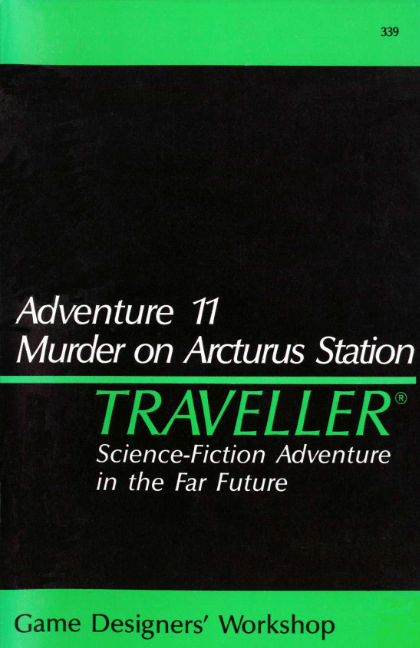
In 1983, Games Designers’ Workshop released an adventure module for Traveller called Murder on Arcturus Station. It’s a straight-up sci-fi murder mystery – an early landmark in Traveller‘s goal of taking play out of the dungeon and zooming off in every direction possible.
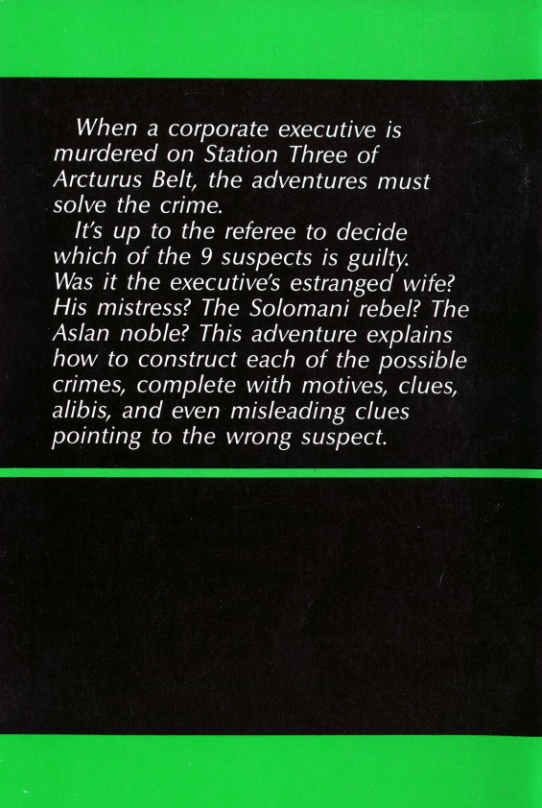
There’s lots to like about this little adventure. The dead body is a sleazy capitalist, who in the premise of the adventure has just screwed the players’ characters out of payment for their last job. There’s also labour strife brewing because the aforementioned bossman is screwing everybody on this little mining station. There’s almost a dozen suspects, each of them having some kind of grief with him. It’s the slick neo-noir vibe of Picket Line Tango but done with all the lack-of-flair of 40 years ago.
But the best thing about the module is that there’s no canonical murderer. As a part of prep, it asks the GM to decide.
I love this because there’s a lot of discussion these days about games that use Brindlewood Bay‘s mystery system. And while this isn’t the same thing by any means, it’s still mucking around in the same sandbox. Essentially, you could say that games like Brindlewood Bay or Apocalypse Keys are just respecting that time-honoured tradition of storygames and redistributing the role of the GM.
When I read Arcturus Station, I have this lovely premise dripping with potential and I don’t want to puncture it. If I was running this in 2016, I would’ve just used smoke and mirrors – pretended that I knew which suspect did it but really I would just see what my players thought and then use that to decide. (Someone on Bluesky called it “planning behind” rather than “planning ahead” and I find that phrase very funny.) All these new games do as far as I’m concerned is let me be honest about my smoke and mirrors.
But the creativity of Arcturus Station doesn’t stop there, it offers two more ideas, half-baked in that classic old school way but still very endearing: what if the one of the player’s characters did it (makes sense, they have a motive, they just got screwed) and what if instead of playing adventurers, the players took on the role of the NPC suspects and basically larped it.
The designer of this module, J Andrew Keith, doesn’t actually know how to pull either of these two things off. Well, the first one is a bit easier. It just requires planning and collusion between one player and the GM. But the second idea is just tossed in at the very end of the book. All that Keith has got to offer us is: “One other possibility which there was no time to explore in detail here is to dispense with the standard player characters and use the suspects as player characters. Give players the information on Katarin Xuan, Eayukheal, and the others, and have them play those roles; of course, one of them will be the murderer…”
Like with many other art forms, one way to read the history of RPG design is the push and pull of experimentation and consolidation: there are periods of obvious and widespread experimentation and then consolidation as the most popular experiments become the norm. But then people get bored of the norm as it looses the novelty that made it popular in the first place and a new phase of widespread experimentation follows.
It’s never so simple, of course. You can have experimentation in one space and consolidation in the other. But it’s interesting to see the creative overreach of the first decade of RPGs – people imagining possibilities but not really having the tools to implement them. It’s the same spirit that draws me towards the current indie games era (and the Forge era, and so on). It’s excitement for the possibilities of play.
Yours, solving mysteries,
Thomas
PS. Bluesky has been nice so far. Very cheerful, very active. If you’re there, reach out at newmadras.bluesky.social
II. Media of the Week
- This a nice video about the real appeal of settings that are in the active process of decomposition and reconstruction.
- You too can support the newsletter on patreon!
- If you’ve released a new game on itch.io this month, let me know through this form so I can potentially include it in the end of the month round-up.
III. Links of the Week
- For Rascal, I write about my experience playing Steal Away Jordan, a 2007 game about slaves in the antebellum south: “This is not a game about suffering. It wasn’t created to make me feel sad or teach me something… This is a game about freedom, sacrifice, and heroism.”
- On Wyrd Science, a conversation about Chaosium’s Rivers of London RPG based on the books by Ben Aaronovitch.
- Seedling Games have published the core of their very useful zine Procedures to Discover the Path Ahead on their blog. It’s a depthcrawl-style process that helps you map out what’s ahead of you as you journey but you can use it to prep too.
- Based on our conversation on my podcast, Elliot Davis has written a nice post about building games around diagetic objects.
- Hark at Them is a new blog from Marx Shepherd and they have a nice review of Stealing your Heart, a duet game of regency romance, from Josh Fox.
- Goblincow has finished their 14,000 word exploration of Mork Borg!
- Personabler sparked off a nice discussion about lethality in old school games. Their bespoke table for more interesting (mostly strange and surreal body transformations) alternatives to death is really fun.
- This reminded me of a post I haven’t shared which is Eero Tuovinen’s post about the “sacrament of death” in deadly games. It’s an exploration of what it means to have a game where you care about your characters but they can die at any time.
- Smithsonian Mag published an article on some of the prehistory of “choose your own adventure” narratives: “It’s American authors Doris Webster and Mary Alden Hopkins who get credit for pioneering the concept as we know it today with the 1930 publication of Consider the Consequences! The romance novel, which included 43 alternative endings, empowers the reader to decide the fates of Helen Rogers and her suitors Jed Harringdale and Saunders Mead.”
Misc
- On EnWorld, an analysis of how the first three hours of a kickstarter let you predict the entire thing.
- Sprigs and Kindling is a new free digital fanzine for games based on Brindlewood Bay.
From the archive:
- Really iconic essay from Meghna Jayanth about “white protagonism and the imperial pleasures of game design“. It’s a very deep dive into the current paradigm of games – what we think a fun game should contain in terms of stories, mechanics, and more. (Issue 70, December 2021)
IV. Small Ads
All links in the newsletter are completely based on my own interest. But to help support my work, this section contains sponsored links and advertisements. If you’d like your products to appear here, read the submission form.
- Who killed Brianna Pilgrim? Solve a murder and prevent a war in Orgy of the Blood Leeches, a deluxe campaign adventure for Mothership 1e, now on BackerKit Crowdfunding as part of Mothership Month.
- Millennial Hiring Managers is a hack of James D’Amato’s Millennial Apartment Hunters. It is a satirical descriptive corporate-horror game exploring the disheartening process that young managers experience as they recruit and hire in a competitive capitalist hellscape.
- Uncover the secrets of the Peloponnesos in The Isle of Pelops, the third supplement for the AEGEAN roleplaying game! This new book will provide setting guides for the prominent cities along with new options for GM and PC alike.
This newsletter is sponsored by the the wonderful Bundle of Holding.
- Get two settings for TORG Eternity, Pan Pacifica and Tharkold, in the new bundle.
- The Gnomestew team’s line of GM guides and prep tools is back.
Hello, dear readers. This newsletter is written by me, Thomas Manuel. If you’d like to support this newsletter, share it with a friend or buy one of my games from my itch store. If you’d like to say something to me, you can reply to this email or click below!


 Indie RPG Newsletter
Leave a comment