I. Dear Reader,
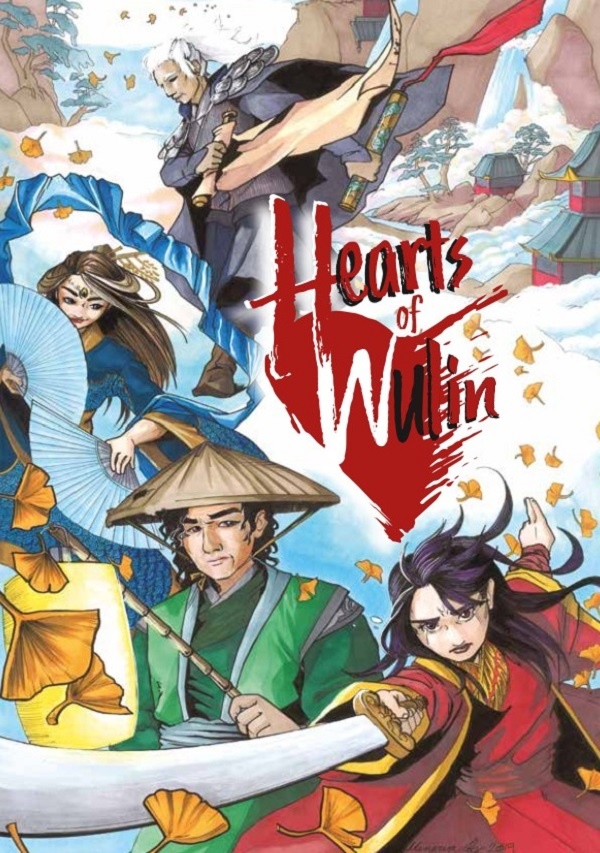
Apart from Urban Shadows 2e, I’m also playing Hearts of Wulin with some lovely folks. For those who don’t know, Hearts of Wulin is a game of wuxia melodrama. There are a lot of wuxia games out there that are focused on the gravity-defying wirework and the martial techniques (with their ornate names) and sure, that stuff is fun but I have no interest in those games. Hearts of Wulin shines because of that second part – the melodrama.
Melodrama falls in a weird space for me because primarily, it makes me think of the kind of bollywood movie I don’t watch. The movies I avoid like I’m allergic to them. But why do I like it in games?
Melodrama is about grand emotions, simply felt. (Drama is when the emotion isn’t simple, I guess.) It’s about heightened feelings played completely straight, no winking irony. I’m not proud of my how essential that irony is to me – how difficult it is to not be embarrassed by simple emotion – but that sadly is the case.
Hearts of Wulin understands that melodrama is appealing but is hard to sustain. You have a scene of love or vengeance – it’s big, it’s over-the-top but then what happens? Passionate people push towards climactic outcomes. How do you go big but not immediately end the story? Hearts of Wulin has a very simple answer: you run away. Through its move design, it creates a loop where players are constantly wrestling with their big, stupid feelings but before they can say the things that need to be said, the scene ends. This is the key: big emotions, never spoken.
I cannot overstate how fun this loop is. At the start of the game, you entangle yourself with other characters into these fraught situations and then you spend session after session, going right up to the point of resolution and then being pulled back. It’s the same formula behind award-winning Starcrossed.
The interesting thing is that running away can be played seriously or ironically. It might be a poignant retreat or it can be chaotic, panicked fleeing. Regardless, it releases the tension (without eliminating it) and stops the game being one-note. We tend to play it for laughs, mostly. Because it’s very funny. And also, aforementioned fear of emotion.
There’s lots to say about this game including how it has much more empty space than most PbtA games (no moves for everything!) but this is its core genius. I’m putting it alongside Pasion de la Pasiones on the metaphorical shelf for games that are definitely someone’s favourite game waiting to be discovered.
Yours, channeling pseudo-Hemmingway, twice,
Thomas
PS. I’ve always wondered why there are so many games (or media, in general) about teenagers. Because this is a cultural thing. Playing teenagers doesn’t have the same thrill around the world, trust me. But in the English-language, trashy teenage fiction is the last bastion of melodrama. It feels like a natural place to go to if you want those feelings.
PPS. For more info, the designer has a thorough introduction to the game here.
II. Media of the Week
- AA Voigt talks about Confluence: the Living Archive and its approach to make in-world setting books with secrets in the notes.
- You too can support the newsletter on patreon!
- If you’ve released a new game on itch.io this month, let me know through this form so I can potentially include it in the end of the month round-up.
III. Links of the Week
- Nice post about what makes a game slow: I’ve come up with four distinct sources of slowness: pondering, friction, too-damn-much-to-do, and inattentiveness.”
- On Rascal, Rowan Zeoli reads Settlers of a Dead God, an adventure for Old School Essentials, where you are bugs “fighting for the rotting scraps of a dead world” and can’t help but relate.
- Wolfgang Baur of Kobold Press writes up his advice for breaking into professional game design.
- Related to last week’s post about the Italian RPG scene, Geek Native reports that Jon Peterson has co-curated an exhibition there on 50 years of D&D art.
- Playful Void has a nice blog about how to do rumours effectively: “People don’t speak in generalities, they’re specific, more often than they’re right.”
- On tumblr, Mint writes up a nice review of Nibiru, the sci-fi game of lost memories.
- Another essay on tumblr, this time from the designer of As the Sun Forever Sets, the war of the worlds inspired game from Evil Hat, as she explores its various media inspirations: It’s “about an apocalypse as it begins, not after it’s over. “
Misc
- Tiny Table Index is a slick crowd-sourced database of solo and duet games.
- Late catch: The IGDN Indie Groundbreakers are open for submissions till the end of October, which is very soon.
From the archive:
- Yochai Gal maintains an excellent page on itch with art assets and other stuff useful for graphic design and lay out for games. (Issue 63, October 2021)
IV. Small Ads
All links in the newsletter are completely based on my own interest. But to help support my work, this section contains sponsored links and advertisements. If you’d like your products to appear here, read the submission form.
- When you’re the first to arrive at the TTRPG table, whip out 🎲DIE in a Dungeon while you wait for your party and turn your dice into doomed heroes!
- The Time We Have: A Conversation Between Brothers is a tragic two-player zombie TTRPG played on opposite sides of a closed door. Launching on BackerKit 10/29!
This newsletter is sponsored by the the wonderful Bundle of Holding.
- British horror comedy game, TEETH, is now available in all new bundle with some fun one shots
- Grizelda’s Guides adds dark fantasy and spookiness to 5e
Hello, dear readers. This newsletter is written by me, Thomas Manuel. If you’d like to support this newsletter, share it with a friend or buy one of my games from my itch store. If you’d like to say something to me, you can reply to this email or click below!
 Indie RPG Newsletter
Leave a comment