
I. Dear Reader,
What is your relationship with the characters you play in RPGs? What do you want it to be?
In Traveller (the classic version, I add, tipping my hat), you make a character through what is now called the “lifepath method”. That name is a bit misleading because in this game, it’s more of a career path. And maybe more specifically, your military career path. Traveller was a game of veterans and if you want to get complicated, that’s what we should talk about. But let’s keep it light and focus on this unassuming table:

Now honestly, this table is iconic but I couldn’t make sense of it without having read the rules of the game (twice). But to put it simply, you’re rolling dice to see which branch of the intergalactic military you joined (either enlisting in your first choice or being drafted by whoever would be willing to take you). Then, you roll to see if you survive your first term, whether you become a commissioned officer, whether you get promoted, and whether you’re allowed to re-enlist for the next term or forced into an early retirement. If do re-enlist, you repeat the process till you retire or die.
Apart from picking your first choice (which you might not get), there are no decisions made in this process (don’t disagree yet!). You roll the dice and whatever happens to your character, happens. You just find out. You might die – and if you’re serving in the Scouts, it’s very likely you do – and you just have to start again with a new character. I think consensus is that this method can be surprising but detached.
Let’s talk about Champions. Traveller came out in 1977 and was revised constantly over the next decade. Champions came out in 1980 and is remembered by many as the classic superhero RPG. In 1984, we got Champions 3e which I understand is what cemented it as a landmark in RPG history.

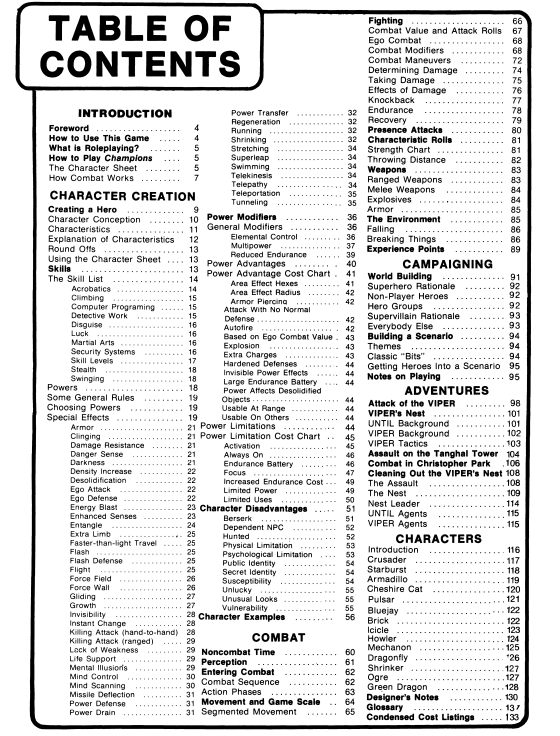
In Champions, you build your character. You get skills (Security Systems, Swinging), Special Effects (Extra Limb, Mind Control), Advantages (Useable at Range), and Disadvantages (Unusual Looks). You pick your skills, spend power points to buy your powers, balance your advantages and disadvantages, and come out the other end – sometimes hours later – with your character. It’s fair to say that Champions is only decisions – it’s nothing but decisions. And that feels different. I think consensus is that this method has lots of strategy and self-expression but is very involved.

At first, it feels like these two games are on opposite ends of a spectrum. But actually, there’s a contradictory impulse in both of them. When you play Traveller, it’s a step-by-step process of discovery. You roll the dice and learn something about the character and then you immediately contextualize it. With every fact you learn, you spin the fiction. If you needed to roll a 7 to not die and you roll exactly a 7, you think, “Wow, they must’ve had a near-death experience. What could it be?”. And these are decisions. Big, important, affecting decisions. Often Traveller‘s lifepath doesn’t spit out a random character, it spits out someone that you’ve closely watched struggle and live for years before they come to you. If that doesn’t make you care about them, what is? At the same time, when you play Champions, you can build and tinker and strategize and eventually make somebody who you might not actually enjoy playing. Sometimes, you get caught up in the general aura of optimization and make somebody effective but that isn’t the same as somebody fun. Or you build them “wrong” and you get a character that is out-of-step with the rest of the group in power, which ends up annoying in other ways.
To zoom out a little, this spectrum of controlled character creation starts to look a little superficial. Reality is much more complicated. Random can become involved and self-expression can become detached. So then what about about these two different methods is actually the important part?
Secretly a history post,
Thomas
II. Media of the Week
- On Youtube, Harmony Ginger talks to Keith Davis about what its like to play D&D in prison.
- There’s a fun double-bill with Party of One presenting a slick actual play of the bleak comedy game, Desperation. Then, on Dice Exploder, the two players analyse the game’s core mechanic and discuss what they liked about it. I’d never played Desperation before but over the course of these two episodes I’m convinced that it’s dark, delightful design.
- Thank you to new patron Keith and existing patrons, Lojaan, Cass, and Somanyrobots. You too can support this newsletter over on patreon!
- If you’ve released a new game on itch.io this month, let me know through this form so I can potentially include it in the end of the month round-up.
III. Links of the Week
- On the Elin Dalstål’s Bold and Vulnerable blog, a great post that outlines the entire idea of what it means to play boldly: “Challenge yourself. Go beyond your comfort zone. Decide to do something you are not sure you can actually pull off. Try something new. Let your character be made a fool, or be seduced by the enemy. Play boldly. Let yourself be vulnerable.”
- Another great bit of analysis from Levi Kornelsen: the spectrum of proceduralization that game can have – with 0 being totally freeform and 8 being completely automated.
- On the Teeth newsletter, a lovely essay about Feng Shui and blossoming possibilities: “Suddenly… I was up against a situation where, if I said “I shoot the guy,” my character would almost certainly miss. But if I said that they slid along a bartop blasting up bottles of vodka as improvised mid air incendiary devices, and then lit a half-chewed cigar on the smouldering corpses of my enemies, well, then that was almost certainly going to happen as described.”
- In his newsletter, Quinn Murphy discusses why we want games to play fast: “Should we be rushing our conversations? I don’t think I’ve had a conversation I consider great where someone was looking repeatedly down at their watch.”
- On Age of Ravens, an alternative for last week’s d100 city events table that is tailored for superhero games.
- Uncanny Ramblings makes a list of popular OSR settings.
- Unboxed Cereal writes about Japanese fantasy RPG, Sword World, and its uncanny parallels to D&D: “You don’t add your ability score to rolls, you add your Ability Modifier, which is exactly what you think it is. This is even funnier than having six stats—people would call you a liar right to your face if you claimed that you had a score/mod duality for any other reason than D&D-brain.”
- Beau Rancourt does another exhaustive audit of a D&D adventure, Tower Silveraxe. One person’s nitpicking is another person’s attention to detail.
From the archive:
- Lowell Francis write about how he runs 200+ sessions in a year over 25 different games. (Issue 46, June 2021)
IV. Small Ads
All links in the newsletter are completely based on my own interest. But to help support my work, this section contains sponsored links and advertisements. If you’d like your products to appear here, read the submission form.
- Kickstart Plasmodics: mutant freaks in the weird future today! In the remnants of the world, play in the smithereens, where (sorta) humans, (kinda) animals, (mostly) robots, and (definitely) aliens join hand-in-mutated-hand.
- One of Us Will Die is an upcoming TTRPG in which one player is aware their character will die and everyone else needs to figure out who it is!
- Miami 86 RPG is live and reached its goal in 40 minutes! The TTRPG inspired by Miami Vice, Scarface, and Vice City is live on Gamefound.
This newsletter is sponsored by the the wonderful Bundle of Holding.
- Check out the Dying Earth adaptation of Dungeon Crawl Classics
- Also, for completely free, Phones of Glory, a game to boost voter turnout from Jason Morningstar
Hello, dear readers. This newsletter is written by me, Thomas Manuel. If you’d like to support this newsletter, share it with a friend or buy one of my games from my itch store. If you’d like to say something to me, you can reply to this email or click below!


 Indie RPG Newsletter
Leave a comment